.svg)
%201.svg)
How AI Models are transforming target discovery and scaling CRISPR screens
%20(1).svg)

May 11, 2026
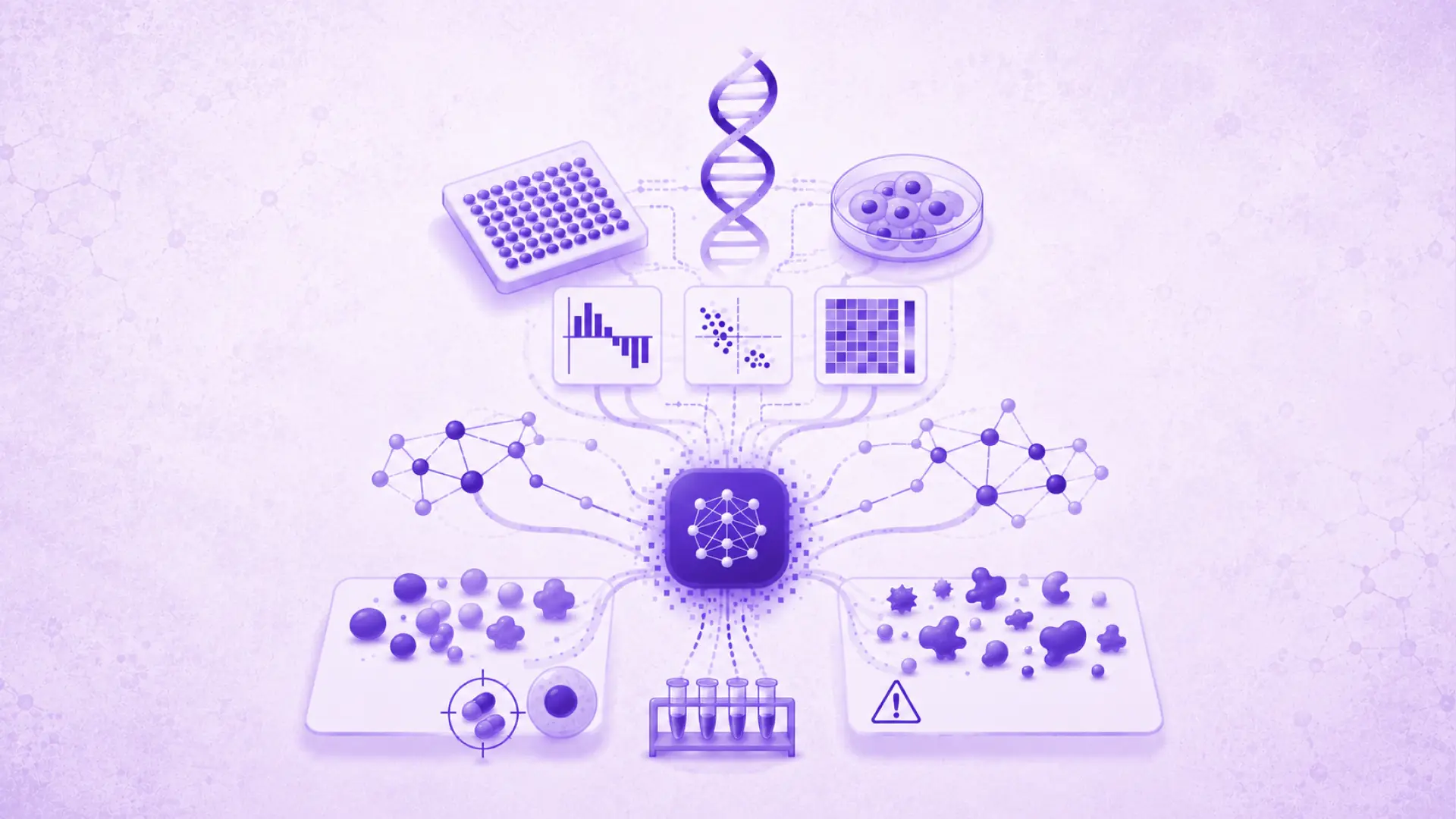
In target discovery, single-gene knockouts are a powerful starting point, but they rarely capture the full reality of complex human disease. A standard CRISPR screen might yield a promising single-gene hit, but block just one pathway and the disease simply reroutes. To develop truly transformative interventions, like combination therapies or drugs that trigger synthetic lethality to overcome drug resistance, discovery programs must move beyond single-gene knockouts to hit multiple targets simultaneously. But mapping this genetic interaction manifold in the physical lab creates an immediate scaling crisis worth approx. $500K-$700K.
To bypass the massive cost and limitations of physical screens and wet lab experiments, leading biotechs are moving target discovery and validation layer entirely in-silico. By leveraging Elucidata’s El-Perturb, our advanced perturbation prediction model, computational biology teams can forecast the cellular response to complex, multi-gene knockouts across unseen contexts computationally to isolate target pairs and protect million dollar validation budgets before a single physical assay is run.
Running a genome-wide CRISPR screen for a single target is expensive but achievable. Moving to combinatorial screening, however, introduces a scaling bottleneck for the physical lab:
Even when teams manage to physically screen a sub-set of combinations, traditional viability screens only answer a binary question: Did the cell live or die?
To understand why a combination works and whether it will trigger off-target toxicity, the industry is shifting to high-dimensional readouts like single-cell Perturb-seq.
However, this creates a new bottleneck. Integrating transcriptomics with broader multiomics data (like proteomics and epigenetics) to decode complex epistatic interactions (where the effect of one gene depends on another) generates a massive, overlapping data swamp. Standard bioinformatic pipelines simply cannot resolve this multiomics complexity.
To solve this math problem, computational biology teams are turning to AI models to simulate these screens. But there is a trap: many highly publicized foundation models fail spectacularly at this specific task.
If standard AI models struggle with Out-of-Distribution (OOD) failures on single targets in novel cell lines, they completely break down when asked to predict the overlapping biology of two unseen targets.
Because the assumption that training and testing data come from the same distribution is heavily violated in combinatorial space, typical model performance falls off a steep cliff. Relying on standard foundation models to predict complex synthetic lethality risks advancing costly false positives.
To bypass the combinatorial trap, we replace physical guesswork with a defensible, in-silico pipeline:
1: Structuring Biological Context (Polly KG)- Before you can predict how a combination behaves, you need a foundation of biological truth. The Polly Knowledge Graph structures complex multiomics data into actionable biological context.
2: Simulating transcriptional responses In-Silico -
3: The Honest Confidence Scoring- AI hallucination in multi-target screening is a financial risk. To protect your validation budget, El-Perturb applies a strict confidence score to every prediction.
You no longer walk into a program review with a fragile, biased list of targets. You walk in with a defensible shortlist of confident targets, backed by structured multiomics context, OOD-aware predictions, and an honest confidence level that protects downstream validation budgets.
Connect with us and Discover how El-Perturb, our in-silico prediction model can solve the critical bottlenecks of CRISPR screens and transform your target discovery pipeline.


.svg)
.svg)


%201%20(1).svg)


%201%20(1).svg)




%20(1).svg)




.svg)
%20(1).svg)


