.webp)


.webp)

.webp)


.webp)

.webp)


.webp)


.webp)

.webp)


.webp)

.webp)


.webp)


.webp)

.webp)


.webp)

.webp)


.webp)


.webp)

.webp)


.webp)

.webp)


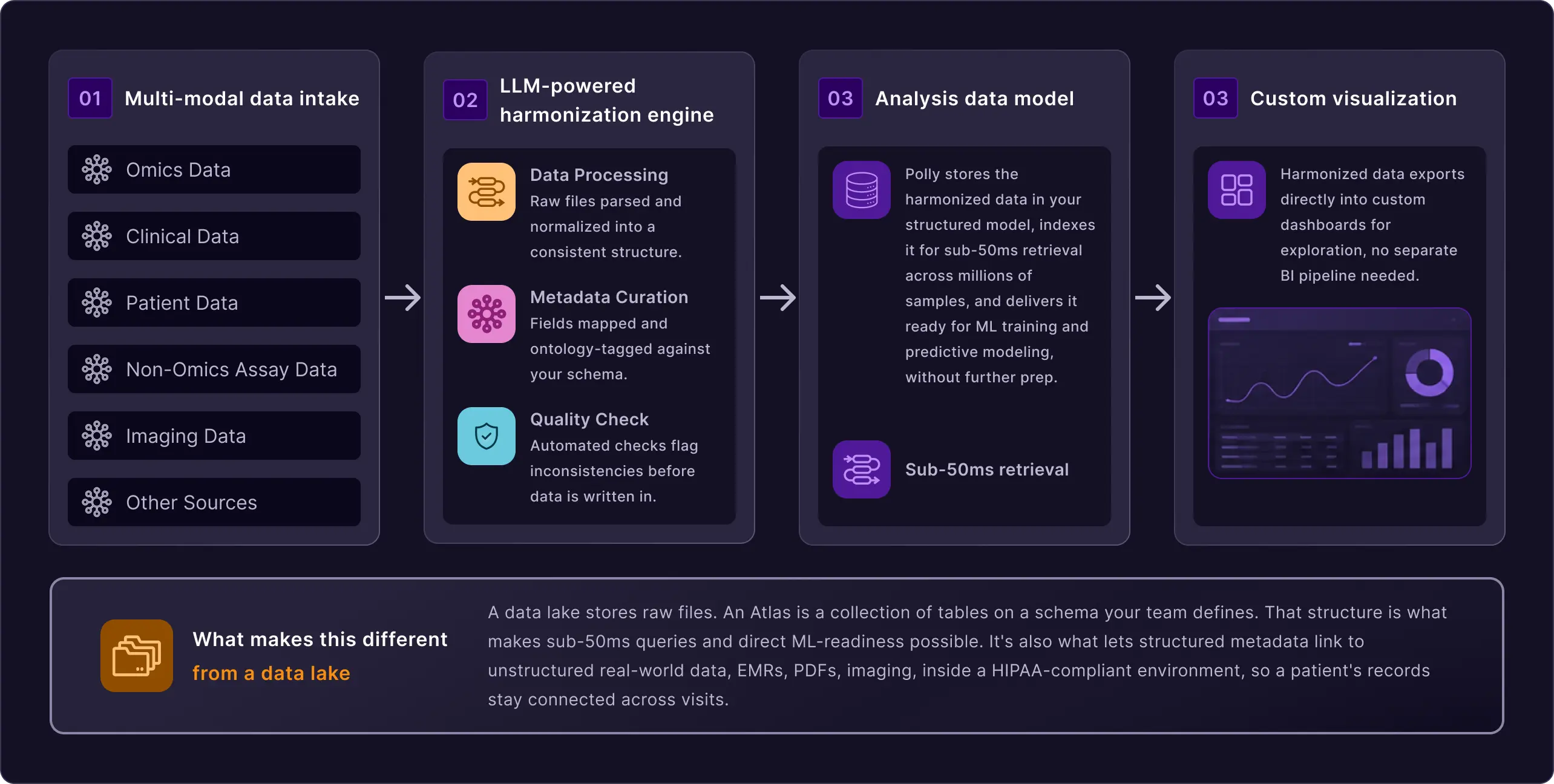
Once your data is harmonized into Atlas, every downstream analysis step runs on the same foundation.
With all data standardized and integrated, comparing previously siloed datasets becomes seamless, ready for differential expression or cohort comparison on day one.
Navigate linked structured and unstructured data intuitively within a HIPAA compliant environment using GUI, Polly Co-Scientist, MCPs, APIs, Polly Python SDKs.
Genomic, transcriptomic, and clinical phenotype data share the same schema enabling seamless cohort construction downstream.
A user-defined schema, an automated harmonization pipeline, and query speed that holds at scale.

.webp)


Atlas is the harmonized data layer most of Elucidata's partnership models are built on or write into.
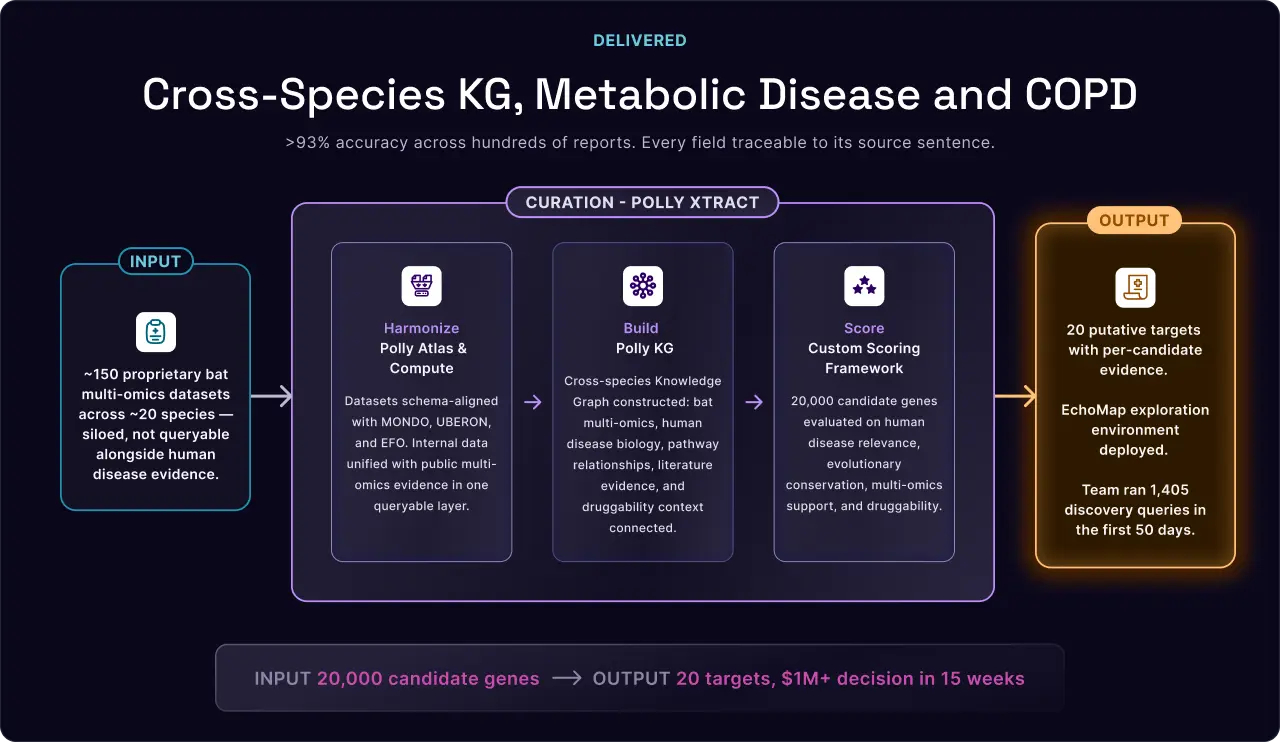
Atlas is the harmonized foundation a Program Partner engagement's knowledge graph is built on, single-cell RNA-seq, spatial transcriptomics, clinical phenotype, and GWAS data sharing one schema before the graph or cohort work begins.
Atlas is the delivery target for Data Harmonization Partner engagements, the structured repository that harmonized, ontology-mapped data lands in and stays queryable from the day the pipeline goes live.
When Elucidata owns a customer's computational infrastructure layer, Atlas is the structured data environment that layer runs on, the schema every downstream pipeline, dashboard, and AI workflow queries against.
When cross-functional teams solve bioinformatics problems—from single-cell annotation to new spatial data types, Atlas is where the structured output lands, queryable the same day. It also supports translational work: building multi-omic and clinical profiles of patient subgroups from data already in the same schema, so cohort construction doesn’t require a separate harmonization pass.
We integrate Atlas into your program infrastructure in the model that matches your team's setup.
Web interface for cohort building, dataset exploration, cross-study comparisons, and launching analysis directly.
A query-driven interface that surfaces Atlas data alongside knowledge graph evidence, for integrated target ID workflows.
Connects your AI tooling directly to your program's Atlas, queryable in plain language.
We wire Atlas into your pipelines through the Polly Atlas REST API, with harmonized data, schema retrieval, and full programmatic access.
Call Atlas data into your workflows & analyses through the Polly Python, with harmonized data, schema retrieval, and full programmatic access.
Full API documentation and integration guides available on request.
A data lake stores raw files. Atlas stores harmonized, ontology-mapped records on a schema your team defines, with cross-study entity resolution, so multimodal queries run without a separate cleanup step.
Omics (single-cell RNA-seq, bulk RNA-seq, spatial transcriptomics, proteomics), clinical and patient data, imaging, and non-omics assay data. All of it goes through the same harmonization pipeline into one schema.
Both partnership models. In Program Partner engagements, Atlas is the harmonized foundation the knowledge graph is built on. In Data & Harmonization Partner engagements, it's the structured repository harmonized data is delivered into.
Both go through the same harmonization pipeline and land in the same schema. Queries mixing public and proprietary data run without a separate alignment step.
Yes. As your program adds new datasets, public or proprietary, Elucidata's team runs them through the same harmonization pipeline on a cadence agreed with your program, so the schema stays current.
Yes. Atlas links structured metadata to unstructured sources like EMRs and PDFs inside a HIPAA-compliant environment. That keeps a patient's record as one connected view.