Polly KG: Data-Centric Biomedical Knowledge Graph for Target Discovery

Polly KG slashes months off your timeline. Generate hypotheses 75% faster and pinpoint target IDs in six months.

Polly KG’s Edge: A Data-Centric Approach to Target Discovery

01

Data-centric AI
Focus
Data-centric AI Focus
Prioritizes data quality, interpretability, and context over quantity.

02

Customization-First
PaaS
Customization-First PaaS
Prioritizes tailored workflows, scalable deployment, and iterative improvement over one-size-fits-all solutions.

03

Evidence Backed & Traceable
Provides quantitative evidence from domain databases and processed omics, with full lineage - beyond literature-only links.
Explore More

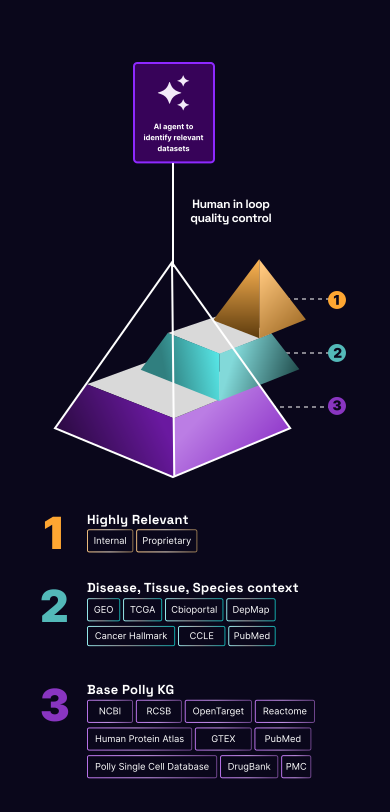
Three-layered Architecture That Holds Biological Context

Explore Capabilities

Real Impact, Real Stories

Case study

Six Months to Success: Accelerating AML Target-indication Assessment With Advanced Knowledge Graphs

View Case Study

On-demand Webinars on Knowledge Graph

Case study: Accelerated Target ID using ML-Ready data on Polly
Incorporating 'Patient Data' to Knowledge Graphs
Read More
Case study: Accelerated Target ID using ML-Ready data on Polly
Polly KG -A Co-Built Knowledge Graph That Evolves With Your Unique Research
Read More
Case study: Accelerated Target ID using ML-Ready data on Polly
Precision at Scale: Agentic AI Delivers Human-Accurate Biomedical Metadata to Accelerate Precision Medicine
Read More

Multi-layered Architecture Purpose-built to Streamline Your R&D Pipeline

Multi-Modal Integration

Unify diverse data, from genomics to clinical records, into a single, comprehensive graph.

Quantifiable Accuracy

Trust human-level accuracy, validated in benchmark studies (e.g., 4/5 drug identifications at P≤0.05).

Scientifically Grounded

Ensures global scientific alignment with 100% ontology mapping and rigorous data validation.

Cross-species Capabilities

Unify knowledge across over 50 species, extending insights beyond human-centric data.

Efficient Data Integration

Seamlessly optimize and integrate your existing, complex data pipelines.

Comprehensive Data Exploration

One view to surface pathways, druggability, interactions, co-expression, trials, and your internal data.

Explore Capabilities

What Makes Polly KG Unique

Natural Language Querying

Explore complex biological systems efficiently, without code or manual searches.

Advanced AI Insights

Get custom target scoring and linkage prediction for precise, multi-indication targeting.

Data-Scarce Adaptability

Excels where traditional KGs fail, providing solutions for non-model organisms and limited data.

Accelerated Discovery

Achieve 75% faster hypothesis generation (months to hours), cutting target ID to just 6 months.

Advanced AI Insights

Get custom target scoring and linkage prediction for precise, multi-indication targeting.

Data-Scarce Adaptability

Excels where traditional KGs fail, providing solutions for non-model organisms and limited data.

Accelerated Discovery

Achieve 75% faster hypothesis generation (months to hours), cutting target ID to just 6 months.

Our Dynamic, Secure Architecture

Our unique, multi-layered architecture ensures you always have the most relevant, secure, and up-to-date information.

Base Knowledge Graph (Base KG)

Broad, regularly updated public knowledge.

Proprietary Layer

Securely integrates your sensitive internal data.

Context Layer

Tailored and frequently refreshed for specific use cases.

The Most Scalable & Comprehensive Knowledge Landscape

Polly KG is built for the future of biology, designed to evolve with your research needs

Scalable Data Landscape

Built on millions of nodes and relationships, integrating 20+ sources, including the largest single-cell data collection.

Cross-Species Capabilities

Unify knowledge across over 50 species, extending insights beyond human-centric data.

Trusted by the World's Leading Biopharma Players

Ready to
Accelerate Your Discovery

FAQs

Why does target discovery remain time-intensive despite access to large-scale biological data?

Despite the availability of multi-omics data, research workflows are often constrained by fragmentation, inconsistent data standards, and limited biological context. These challenges significantly slow hypothesis generation and validation.
Elucidata’s Polly Knowledge Graph addresses this by harmonizing and contextualizing multi-modal datasets into a unified framework, enabling faster and more reliable target discovery.

How can organizations derive actionable insights from complex multi-omics datasets?

Multi-omics datasets are inherently complex and difficult to interpret without structured context. Traditional approaches often fail to capture relationships across data types.
Polly KG applies a data-centric AI approach, organizing data into biologically meaningful relationships that support evidence-based decision-making and deeper insight generation.

What is the most effective approach to integrating diverse biological datasets while preserving context?

Conventional data integration pipelines often lead to loss of biological relationships and context.
A knowledge graph-based approach, such as Polly KG, enables context-aware integration, preserving connections across genes, pathways, diseases, and experimental conditions within a unified structure.

How can false positives in target identification be minimized?

False positives frequently arise from poor data quality, lack of contextual validation, and fragmented analysis pipelines.
Polly KG delivers scientifically grounded, evidence-backed insights, ensuring that identified targets are supported by curated datasets and biologically relevant relationships.

How can research workflows be scaled without increasing operational complexity?

Scaling research workflows typically introduces additional data silos and inefficiencies.
Polly KG is built as a customization-first platform (PaaS), allowing organizations to adapt data models and workflows to their specific needs while maintaining scalability, consistency, and operational efficiency.

How can researchers connect insights across multiple experiments and datasets?

Disconnected datasets limit the ability to generate holistic biological insights.
Polly KG leverages a three-layered architecture-data, context, and insight layers-to connect and contextualize information across experiments, enabling comprehensive exploration of biological relationships.

What is the most effective way to identify new indications for existing targets?

Indication expansion requires integrating signals across diverse datasets, including disease biology, pathways, and molecular interactions.
Polly KG enables systematic exploration of these relationships, supporting the identification of novel indications through a unified and context-rich data model.

How can organizations ensure reproducibility and consistency in data analysis?

Inconsistent data processing and lack of standardization often lead to irreproducible results.
Polly KG provides harmonized, ML-ready datasets and standardized analytical frameworks, ensuring consistent, reproducible outcomes across teams and studies.

How can AI be effectively integrated into drug discovery workflows?

The effectiveness of AI models is highly dependent on data quality and structure.
Polly KG adopts a data-centric AI paradigm, ensuring that models are trained on high-quality, well-annotated, and contextually enriched datasets, resulting in more reliable and interpretable outputs.

What capabilities should organizations look for in a knowledge graph platform for life sciences?

Biomarkers enable early disease detection, improve patient stratification, and guide treatment decisions. In areas like oncology, immunology, and CNS diseases, they play a critical role in advancing precision medicine and improving patient outcomes.

What are the biggest challenges in biomarker discovery and validation?

An effective knowledge graph platform should support multi-modal data integration, contextual modeling of biological relationships, scalability, and seamless workflow integration.
Elucidata’s Knowledge Graph offering combines these capabilities into a purpose-built solution for biopharma R&D, enabling end-to-end knowledge discovery with scientific rigor and operational efficiency.

Technology · Polly Knowledge Graph

Polly KG: Your Knowledge Graph Is Only as Good as Its Evidence.

Elucidata grades every gene-disease relationship as supporting, contradicting, or neutral before it becomes a KG edge, because co-occurrence alone does not tell you which direction the evidence points.

3x

Faster hypothesis generation vs. prior workflows

8M+

Full-text articles processed, into methods and supplementary sections

3

Evidence grades per relationship: supporting, contradicting, or neutral

Technology · Polly Knowledge Graph

Polly KG: Your Knowledge Graph Is Only as Good as Its Evidence.

Elucidata grades every gene-disease relationship as supporting, contradicting, or neutral before it becomes a KG edge, because co-occurrence alone does not tell you which direction the evidence points.

3x

Faster hypothesis generation vs. prior workflows

8M+

Full-text articles processed, into methods and supplementary sections

3

Evidence grades per relationship: supporting, contradicting, or neutral

What target ID teams achieved

What target ID teams achieved

Explore Capabilities
Cross-species KG · comparative genomics biotech

3x

Faster hypothesis generation

Polly KG graded cross-species relationships before the shortlist was built, separating supporting from contradicting evidence across hundreds of candidates
AML target prioritization · clinical-stage biotech

#1

Candidate advanced to Phase 1

Elucidata's evidence package covered ~10 AML hypotheses. The candidate with the highest qualified evidence score on the shortlist advanced to Phase 1.
Explore Capabilities
Technology

Here's how the Evidence Layer works

D/L Type I
HIPAA compliant
ARI 3154 all partners in-use
Tested with AWS VPC

What This Enables in Target ID

Once the knowledge graph is built on direction-graded evidence, your target selection has something to stand on.

Validation-ready evidence — KG-Based Target Validation.

The same knowledge graph that ranked candidates requalifies them at the validation stage. Contradicting evidence noted at ranking becomes a validation gate.

From 20,000 genes to investment-ready targets.

Custom scoring across disease relevance, druggability, and proprietary signal. Delivered in production for COPD, metabolic disease, and complement biology programs.

Foundation for Spatial / GWAS / Patient Stratification programs.

Atlas supplies the pre-harmonized data that Cohorter queries. Cohort construction starts from clean, ontology-mapped records.

Explore Capabilities

Part of the Elucidata service offering

The KG evidence pipeline is what differentiates Elucidata's Program Partner service from a KG license, it's the qualification layer that determines whether the graph is built on graded relationships or just co-occurrence counts.

KG-Based Target Ranking & Co-Build

The primary program type. Elucidata processes 8M+ full-text papers and qualifies every gene-disease relationship as supporting, contradicting, or neutral before writing a KG edge. Every edge carries direction and confidence. Delivered in production for COPD, metabolic disease, and AML programs.

KG-Based Target Validation

The same qualified evidence layer used for target ranking requalifies relationships at the validation stage. Delivered in production for complement-mediated disease programs.

Gene Disease Target Assessment

Polly KG is available as an optional evidence layer in Gene Disease Target Assessment engagements, supplying the biomedical knowledge graph that Polly Lens scores against.

View Solution Briefs

How Polly KG Integrates Into Your Program

We integrate Polly KG into your target ID infrastructure in the model that fits your program.

Polly UI

Web interface for KG exploration, target scoring dashboards, and evidence report generation via Polly Lens.

KG MCP Server

The KG MCP Server connects your AI tooling directly to Polly KG. List graphs, run Cypher, download results. In production as of Q2 2026.

REST APIs

We wire Polly KG into your stack via the Polly KG REST API, with Cypher and natural language queries supported and async execution for large result sets.

Co-Scientist

Guided AI research interface for querying the KG, exploring mechanisms, and generating evidence reports without writing queries. Also available via Slack integration.

Full API documentation and integration guides available on request.

View Solution Briefs
FAQs

Questions From Every Evaluation Call

What is the difference between a co-occurrence knowledge graph and a qualified biomedical knowledge graph?

Co-occurrence counts how often a gene and disease appear together. Polly's KG separates supporting from contradicting evidence before writing any edge. For target identification in drug discovery, that distinction determines which candidates make the shortlist.

What is the difference between KG-Based Target Ranking & Co-Build and KG-Based Target Validation?

Target Ranking narrows 20,000 genes to a ranked shortlist using the knowledge graph. Target Validation uses the same qualified evidence to stress-test specific candidates before wet-lab commit. Both use direction-graded evidence. The question changes: 'who should we pursue?' versus 'does this candidate hold up?'

How does Polly KG support target identification in drug discovery?

The Polly Knowledge Graph gives your scoring layer direction-graded evidence, not raw co-occurrence counts. Candidates with mixed or contradicting evidence are flagged before they reach the shortlist.

Can the knowledge graph handle rare targets or thin literature?

Yes. Full-text processing recovers evidence from supplementary sections and methods text that abstract-only tools miss. Proprietary in-house datasets go through the same qualification pipeline as public literature.

How often is the knowledge graph updated?

PubMed Central literature is ingested continuously. Proprietary data integrates at program milestones.

What stage of target discovery does Polly KG support?

The full range, from initial target discovery through target validation. The same KG that ranks 20,000 genes also carries the contradicting evidence your team needs at the validation stage.

How does AI-driven drug discovery benefit from Polly KG?

AI models that query a co-occurrence graph amplify noise. Polly KG gives AI models qualified, direction-graded inputs, so your models start from defensible evidence.

Your target ID program needs data you can defend.
Let us find it.