%201.svg)

T2D2: Turing Test for Drug Discovery
We're redefining AGI by the value of work it delivers and testing whether autonomous systems can execute expert-level research from raw data to novel insights.
The Framework for Evaluation

Impact & Value
Does it actually de-risk pipeline, speed up the timelines to bring a drug to patients, and reduce operational costs

Success Metrics
Tracking from leading indicators to lagging, long-term impact.

State of the Art
How does it compare to what top competitive teams are doing?
A Pragmatic Taxonomy to measure AGI progress: Competency × Complexity

Complexity
Can it handle high structural depth and ambiguous biological goals?

Competence Profile
Does it possess the requisite reasoning fidelity, domain knowledge, and judgment calibration?
.svg)
Explore Our Use-Cases
%201%20(1).svg)


How Polly Helps?
.webp)
Build a Custom, ML-ready Atlas Specific to Your Research
Develop a customized Atlas with ML-ready data for bias-free target predictions.
.svg)
Create a disease-specific Atlas comprising meticulously curated data enriched with critical metadata and engineered for seamless integration into target prediction models.
Enhance prediction accuracy and mitigate bias through model training with multi-modal, harmonized datasets.
Instill confidence in your predictions by combining consistently processed samples for robust results.

Derive Expression Signatures From Relevant Cohorts
Explore healthy and patient cohorts on Polly for a comprehensive molecular profiling of the disease being studied.
Conduct gene expression analysis to uncover differentially expressed signatures specific to the disease condition.
Identify potential candidate genes by assessing their druggability scores and cross-referencing with publicly available evidence.

Validate Identified Targets With Public Data
Cross-reference your results with published evidence using curated public data delivered on Polly.
Validate target reliability by meta-analyzing relevant studies on Polly.
Evaluate targets for sensitivity, specificity, and clinical utility with rigorous statistical analysis.
Real Impact, Real Stories


%201%20(4).svg)
%201%20(3).svg)
T2D2 Across the Pipeline
Testing AI Against Reality: The Challenges Worth Solving by Turing Test for Drug Discovery
Target Discovery
Raw scRNA-seq Data to High-Conviction Therapeutic Targets: Can AI ingest messy, raw single-cell RNA-seq data, perform quality control, cluster the cells, and find a high-conviction list of therapeutic targets?
Generate a Research Hypothesis with Deep Literature Review: Can AI autonomously scan PubMed and public databases, synthesize the findings, and generate a research hypothesis to start a research project?


Hit Identification & Lead Optimization
Ensuring Molecules Progressing from In-Silico Design are Synthesizable: Can AI produce a library of molecules that score high for binding affinity, have realistic Synthetic Accessibility (SA) scores and high Quantitative Estimates of Drug-likeness (QED)?
Predicting Toxic Liabilities In-Vivo in Lead Compounds: Can AI accurately flag toxic liabilities in a lead compound before we waste millions of dollars testing it in an animal model?
Regulatory Submissions & Translational Research
FAIRification of CRO & Preclinical Data: Can AI synthesize years of deep literature research, ADMET profiles, and preclinical data into a cohesive atlas, that can be used for regulatory filings?
Multimodal Biomarker Panels: Can the AI move beyond single-gene signatures to identify multimodal biomarker panels that accurately predict drug efficacy, before filing an IND application?

Clinical Development
Identifying Trial Responders: Can AI identify compounds whose mechanism of action matches the molecular signature of an underserved disease or a specific cohort of a common one?
Repurposing Failed Drugs: Can AI leverage multi-omic data to differentiate responders from non-responders, accelerating patient enrollment and de-risking clinical trial outcomes?
Process Development
In-Silico Gene Knockouts: Can AI act as an in-silico CRISPR knockout experiment, and predict which gene perturbations lead to improvement in Cell line yields?

How Polly KG Powers Your Research


What Makes Polly KG Unique
Natural Language Querying
Explore complex biological systems efficiently, without code or manual searches.

Advanced AI Insights
Get custom target scoring and linkage prediction for precise, multi-indication targeting.
Data-Scarce Adaptability
Excels where traditional KGs fail, providing solutions for non-model organisms and limited data.

Accelerated Discovery
Achieve 75% faster hypothesis generation (months to hours), cutting target ID to just 6 months.


Advanced AI Insights
Get custom target scoring and linkage prediction for precise, multi-indication targeting.
Data-Scarce Adaptability
Excels where traditional KGs fail, providing solutions for non-model organisms and limited data.

Accelerated Discovery
Achieve 75% faster hypothesis generation (months to hours), cutting target ID to just 6 months.
The Polly Difference
You cannot pass the Turing Test for Drug Discovery framework with noisy public data. Our data infrastructure powers AI that actually works in the translational R&Ds


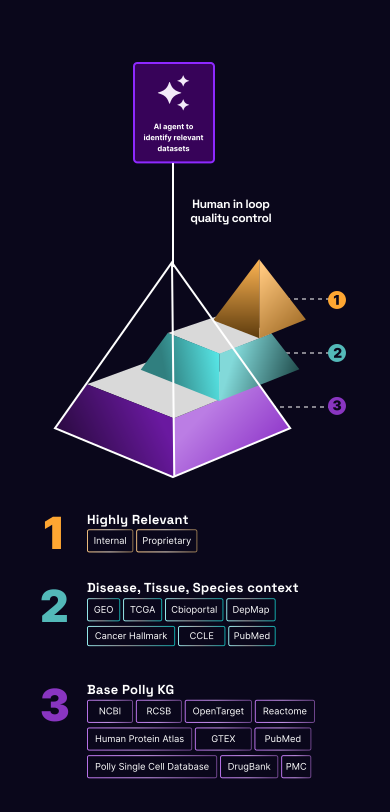
Our Dynamic, Secure Architecture
Our unique, multi-layered architecture ensures you always have the most relevant, secure, and up-to-date information.

Base Knowledge Graph (Base KG)
Broad, regularly updated public knowledge.

Proprietary Layer
Securely integrates your sensitive internal data.

Context Layer
Tailored and frequently refreshed for specific use cases.
The Most Scalable & Comprehensive Knowledge Landscape
Polly KG is built for the future of biology, designed to evolve with your research needs

Scalable Data Landscape
Built on millions of nodes and relationships, integrating 20+ sources, including the largest single-cell data collection.

Cross-Species Capabilities
Unify knowledge across over 50 species, extending insights beyond human-centric data.
Trusted by the World's Leading Biopharma Players
.webp)




.webp)

.webp)


.webp)

.webp)


Accelerate Your Discovery


.svg)

.svg)


info@elucidata.io
.svg)


%201%20(1).svg)
%20(1).svg)
%201%20(1).svg)
.svg)