.svg)
%201.svg)
Polly Co-Scientist: Interactive Analytics Engine for Real-Time Biomedical Insight Generation
%20(1).svg)

March 19, 2026

R&D teams and clinicians deal with massive amounts of biomedical data everyday - from electronic health records and clinical trial datasets to high-throughput omics and imaging studies. Turning this fragmented, multi-modal information into actionable insights, for example, for tracking disease progression, evaluating safety and efficacy, understanding PK/PD relationships, or designing clinical trials, or designing trials often requires high technical expertise and the massive overhead of manual data cleaning and analysis.
Polly Co-Scientist changes that. Through AI-assisted querying with live metadata enrichment, it enables scientists and clinicians to analyze complex multi-modal clinical data using simple natural language. Whether you point it at a new therapeutic area, a different proprietary database, or a fresh set of clinical trials, Co-Scientist instantly adapts and allows you to pull queries, analyse, and visualize entirely new domains with the same natural language ease.
The platform does the heavy lifting of writing the complex database SQL and Cypher queries behind the scenes so researchers can focus on the scientific reasoning. This means you can ask whatever you want or need whether you are exploring data schemas, designing clinical trials, uncovering predictive biomarkers, or conducting hypothesis testing and statistical insights, Co-Scientist pulls out precise insights without writing a single line of code or worrying about exact technical definitions.
Polly Co-Scientist is an AI-powered interactive analytics and visualization engine - a primary interface for exploratory biomedical research. Connected to structured Atlas environments and Knowledge Graphs (we can do internal linking here), it bridges high-level scientific hypotheses with deep technical data execution. It is a collaborative engine that automates the extraction of high-resolution information ranging from molecular mechanisms and patient subgroups to efficacy outcomes and patient recruitment status into a structured, unified format.
Clinicians and researchers do not have to build technical pipelines; they simply ask a question, and the engine translates that scientific intent into a structured, visualizations without needing specialized coding or data engineering support.
Co-Scientist handles the heavy lifting of multi-source data integration and complex analysis and reasoning, so your team can focus on scientific insight:
To ensure absolute precision, Co-Scientist follows a structured pipeline that turns fragmented documents into a dynamic analytics layer:
Making high-stakes R&D decisions demands precision. Polly Co-Scientist has been rigorously evaluated-
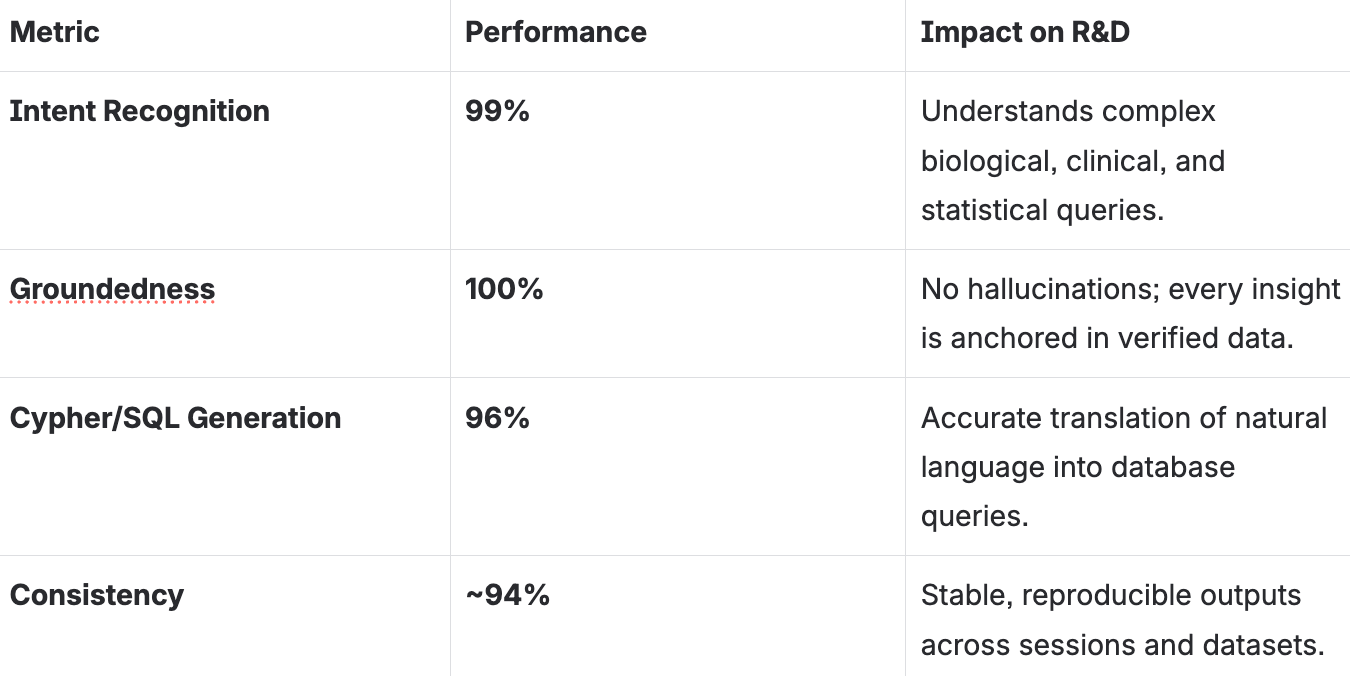
Co-Scientist powers the most critical phases of research and development by bridging multi-modal data:
By moving the workflow from simple chat to an autonomous analytics and visualization engine, Polly Co-Scientist ensures R&D teams moves from discovery to insight faster than ever before.


.svg)
.svg)


%201%20(1).svg)


%201%20(1).svg)



%20(1).svg)




.svg)
%20(1).svg)


