.svg)
%201.svg)
Target Discovery and Independent Orthogonal Validation for Alzheimer's Disease - Tau Pathology
%20(1).svg)

March 9, 2026
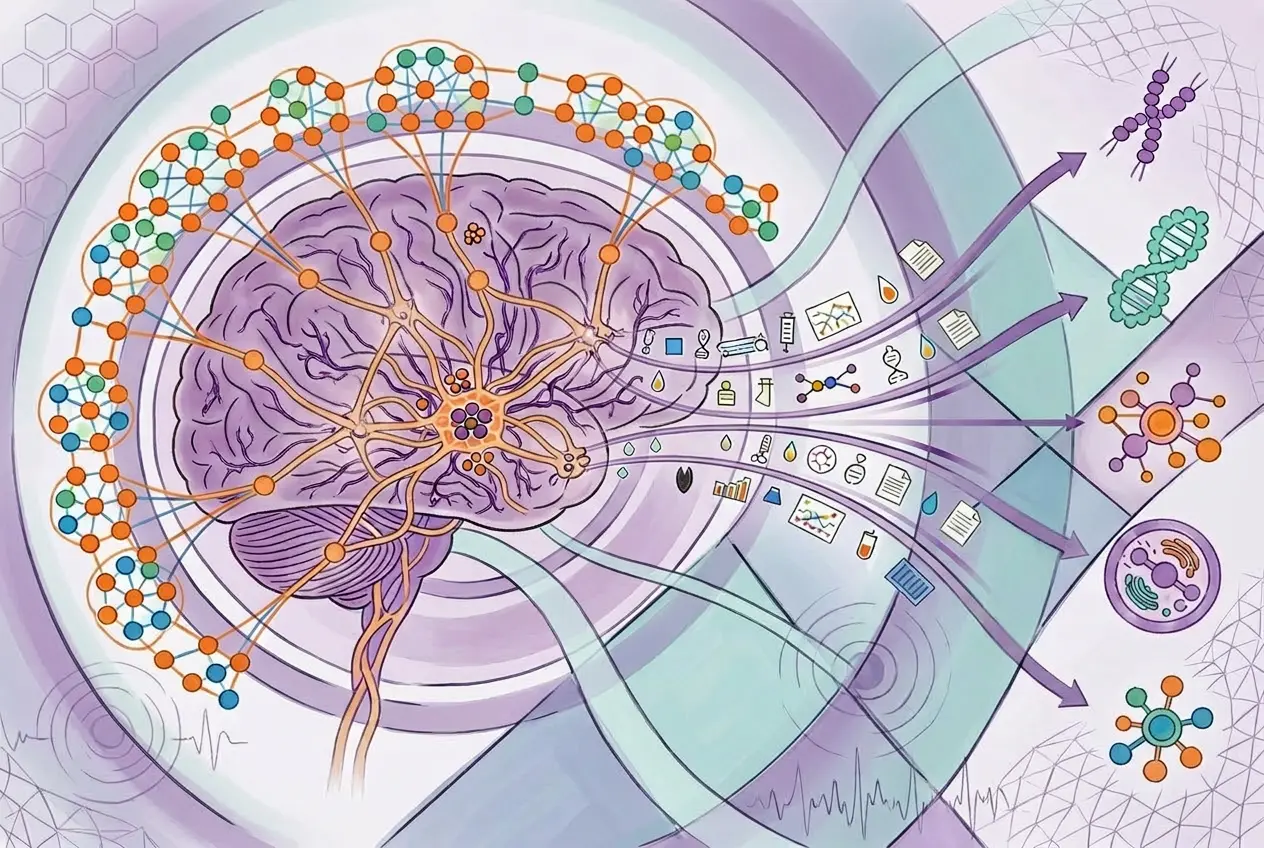
Alzheimer's disease (AD) is the most common cause of dementia globally, affecting approximately 55 million people. While defined by both amyloid-beta plaques and neurofibrillary tangles (NFTs) of hyperphosphorylated tau, it is tau pathology - not amyloid burden, that most closely tracks cognitive decline. The MAPT-encoded tau protein is hyper-phosphorylated by dysregulated kinases including DYRK1A (Thr212/Thr231) and MARK2 (Ser262) causing tau to detach from microtubules, aggregate into NFTs, and propagate in a prion-like manner across brain regions. Anti-amyloid antibodies lecanemab and donanemab achieve only ~30% slowing of progression, making tau the field's next therapeutic frontier.
In tau-centric research, the primary barrier to discovery isn't a lack of data, but a lack of AI-readiness. Integrated multi-omics-combining genomics, tau PET imaging, and longitudinal clinical cohorts-remains trapped in silos that lack the structural and semantic interoperability required for machine learning.
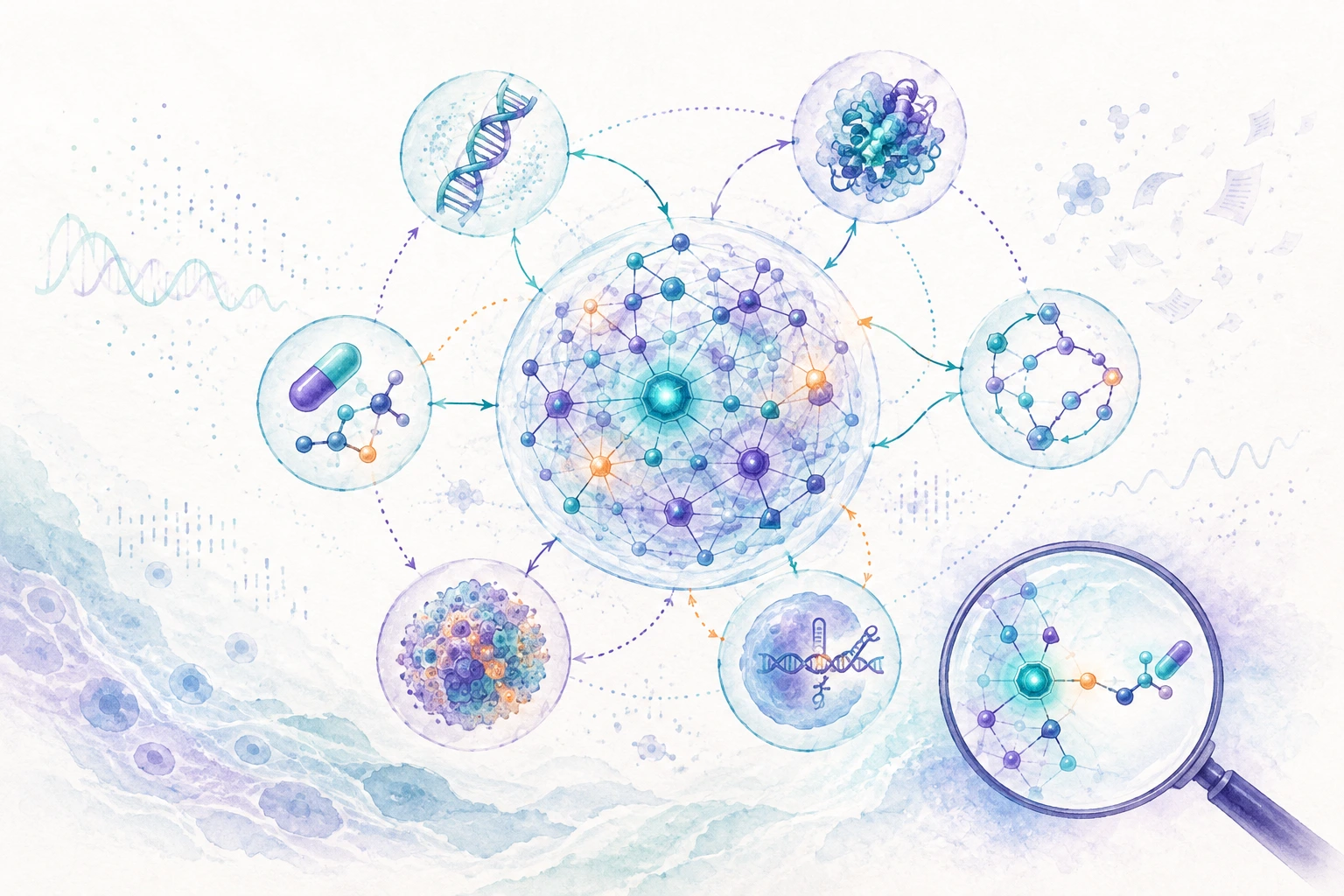
This is where biomedical knowledge graphs play a critical role by structuring fragmented multi-omics data into connected, queryable relationships.
Target Identification and Prioritization using Knowledge Graphs
Knowledge graphs facilitate multi-omics analyses for tau-targeted drug discovery by integrating heterogeneous biological datasets - spanning genetics, proteomics, imaging biomarkers, and clinical evidence - and representing complex relationships across data modalities in a queryable structure. For AD tau research, where the target landscape has evolved substantially following first-generation clinical failures, Knowledge Graphs enable rapid hypothesis testing without bespoke bioinformatics pipelines. The time taken for insight generation is dramatically reduced.
PollyKG has 20+ Disease-Gene relationships curated for understanding pathological roles, gene essentiality, and druggability across neurodegenerative indications including tau-driven Alzheimer's disease.

A key strength of this subgraph is what it surfaces beyond the canonical target. DYRK1A and MARK2 first appeared in the 187-row protein-centric query via has_functional_perturbation_of edges on regulation-related GO terms. The subgraph query then confirmed their connections to MAPT more precisely via interacts_with_gene edges - MARK2↔MAPT from SIGNOR (PMID:10090741) with a STRING interaction score of 0.979, and DYRK1A↔MAPT from SIGNOR (PMID:21215781) with score 0.747. Both are annotated to GO:1902996 (regulation of neurofibrillary tangle assembly), which is the upstream regulatory process - distinct from GO:1902988 (neurofibrillary tangle assembly) anchoring MAPT itself. This is a target expansion capability that a PubMed search would not naturally converge on: a researcher focused solely on tau antibodies might never consider that DYRK1A inhibition represents an orthogonal therapeutic strategy targeting the same pathological process one step earlier - at the point of tau hyperphosphorylation itself, before aggregation begins.
Disease–Gene Associations that are Evidence Backed
Important context: MAPT variants do not directly cause sporadic AD. Tau hyperphosphorylation is a downstream pathological consequence - the executor of neurodegeneration - not the primary genetic driver. Accordingly, PollyKG encodes MAPT's connection through has_genetic_association_with and co-occurs_with_gene_in_literature edges - reflecting that MAPT mutations cause FTD, not sporadic AD, while tau pathology in AD is a downstream consequence. The KG-confirmed direct link from MAPT to a clinical asset is a has_drug_target edge to Bepranemab. DYRK1A and MARK2 connect via interacts_with_gene edges, placing them upstream in the tau phosphorylation network.
At Elucidata, we use domain expertise to mine evidence from literature and store all relevant information as edge properties that users can query intuitively using NLQ, Graph Explorer, or our Python SDK.

Key Aspects of Target Prioritization
PollyKG provides the following information out of the box for tau-targeted AD research:
PollyKG bypasses bespoke bioinformatics to navigate the tau landscape, where successes like bepranemab (33–58% PET reduction) and etalanetug (2025 FDA Fast Track) mark a major clinical shift. Unlike oncology, tau is a pathological executor, requiring the multi-modal evidence synthesis PollyKG provides to connect MAPT with upstream regulatory kinases like DYRK1A and MARK2.
By integrating next-gen biomarkers, the platform identifies orthogonal intervention points that conventional searches miss. Ultimately, PollyKG converts months of data engineering into days of actionable discovery, accelerating the path to effective neurodegenerative therapies.
Explore our case studies to see how Elucidata’s knowledge graphs power real-world discoveries:
References


.svg)
.svg)


%201%20(1).svg)


%201%20(1).svg)





%20(1).svg)





.svg)
%20(1).svg)


