.svg)
%201.svg)
Polly BioAgent: Transitioning from Code Generation to Autonomous Execution
%20(1).svg)

March 5, 2026
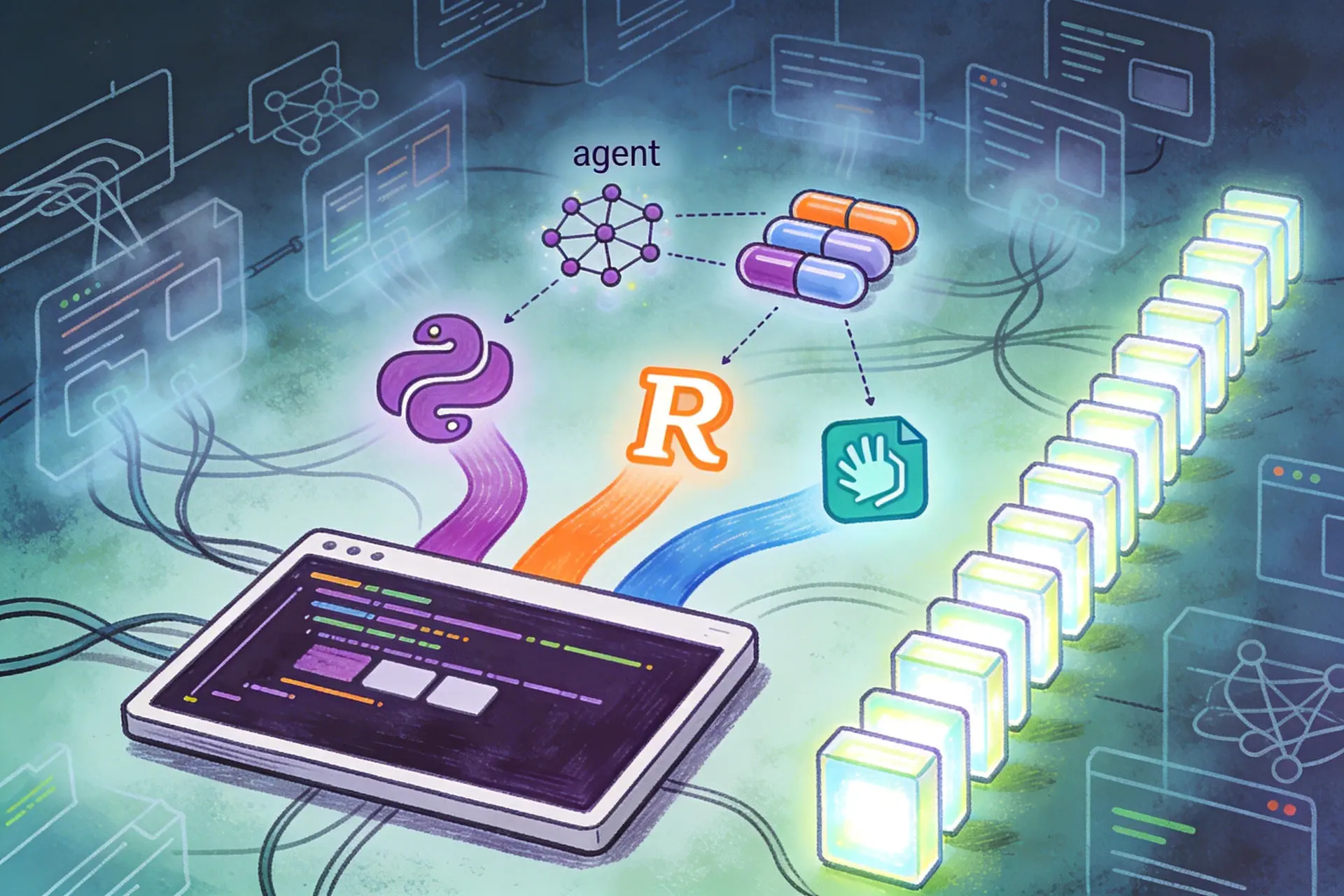
Computational biology has a hidden bottleneck: the manual labor required to make AI-generated code actually run. While modern LLMs are excellent at suggesting snippets, the scientist is still left to manually set up environments, resolve dependency conflicts and troubleshoots, and pipe outputs from one tool into the next.
Polly BioAgent is designed to shift this burden by moving from code suggestion to autonomous execution while retaining the right context for reproducible scientific results.
Current AI tools operate outside the context of a functional runtime. This creates three primary friction points.
BioAgent is a CLI-first system that handles execution, iteration, and artifact management in a closed loop. It doesn't produce a chat transcript , it produces a structured body of work.
To evaluate BioAgent against standard LLM assistants, we used the GSE96583 dataset with critical gene feature files intentionally removed , simulating the kind of messy, non-standard data that shows up regularly in real research.

On representative multi-step omics workflows, we observed an 18x speedup, compressing six-hour tasks into approximately 20 minutes.
By automating the infrastructure layer of bioinformatics, teams can focus on the actual Science.
Consistent Standard- Unified execution across teams ensures everyone follows the same SOPs, regardless of individual environment setups.
Audit-Ready Results- Every run generates an execution system of record, capturing exploratory R&D with full traceability.
Faster Iteration- Scientists can test hypotheses rapidly without the overhead of manual environment setup or data wrangling between steps.
If you're ready to stop managing terminals and start scaling your discovery process, connect with us to explore how Polly BioAgent can integrate into your workflows.


.svg)
.svg)


%201%20(1).svg)


%201%20(1).svg)



%20(1).svg)





.svg)
%20(1).svg)


