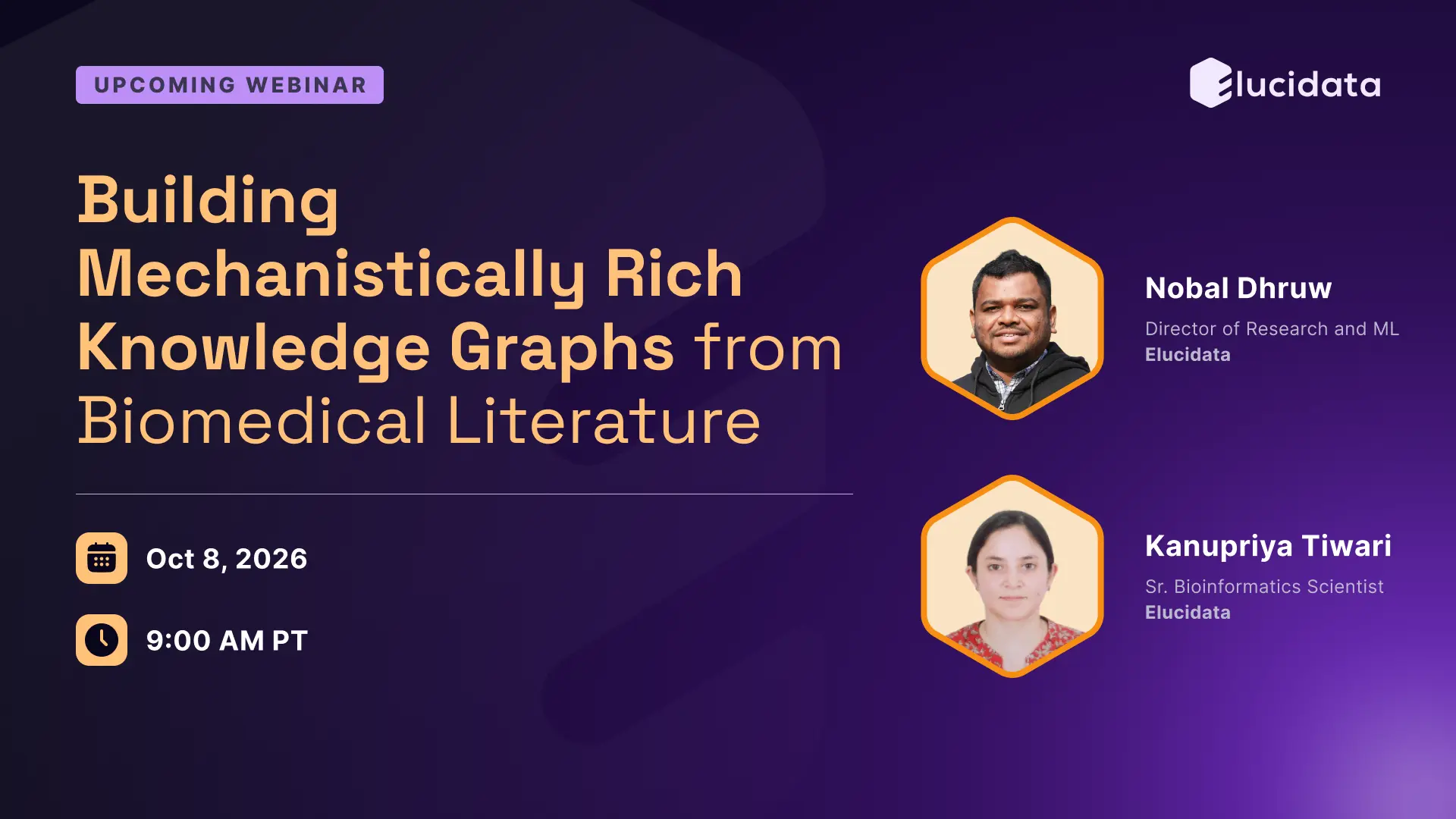

Biomedical knowledge graphs now integrate millions of entities and relationships across genes, diseases, drugs, pathways, phenotypes, and experimental evidence. But for target discovery, the value of a graph depends less on how many connections it contains and more on whether those connections reflect the underlying biology.
Literature is one of the richest sources for these graphs, yet most literature-derived edges record only that a gene and a disease appear in the same sentence. They show that two entities are associated, not how. The same gene–disease pair can appear in very different contexts: a genetic variant may increase disease risk, loss of gene function may protect against disease, expression may change downstream of pathology, or experimental perturbation may show that the gene actively drives progression. These observations should not become equivalent edges in a knowledge graph.
In this webinar, we'll show how models can recover these distinctions from biomedical literature and convert them into structured, traceable relationships: separating causal claims from molecular observations, distinguishing biomarkers from therapeutic targets, and capturing whether an effect promotes or protects against disease.
Using acute myeloid leukemia (AML) as a case study, we'll show how typed relationships make evidence reasoning across a knowledge graph more reliable.



Biomedical knowledge graphs now integrate millions of entities and relationships across genes, diseases, drugs, pathways, phenotypes, and experimental evidence. But for target discovery, the value of a graph depends less on how many connections it contains and more on whether those connections reflect the underlying biology.
Literature is one of the richest sources for these graphs, yet most literature-derived edges record only that a gene and a disease appear in the same sentence. They show that two entities are associated, not how. The same gene–disease pair can appear in very different contexts: a genetic variant may increase disease risk, loss of gene function may protect against disease, expression may change downstream of pathology, or experimental perturbation may show that the gene actively drives progression. These observations should not become equivalent edges in a knowledge graph.
In this webinar, we'll show how models can recover these distinctions from biomedical literature and convert them into structured, traceable relationships: separating causal claims from molecular observations, distinguishing biomarkers from therapeutic targets, and capturing whether an effect promotes or protects against disease.
Using acute myeloid leukemia (AML) as a case study, we'll show how typed relationships make evidence reasoning across a knowledge graph more reliable.




Scaling clinico-genomic data integration: Large pharmaceutical organizations working with external data providers used Polly to build interoperable clinico-genomic data products 6x faster.
Although purchased datasets are often labeled as "clean," they still lack interoperability—Polly's pipelines bridge this gap with robust integration and harmonization.
Information Retrieval: Drug safety monitoring teams used Polly's Knowledge Graph powered co-scientist to conversationally retrieve the right cohorts & assess drug response—cutting discovery time by 70%.
%201.svg)


.png)
.png)
.png)

.png)


If you’re working with complex biological data, you may be asking:
Can generative AI truly assist in scientific reasoning, not just data analysis?
What does it mean for hypothesis generation, literature review, or even designing experiments?
Could this accelerate—not replace—my discovery pipeline?
Whether you're skeptical, curious, or already experimenting with AI in your lab—this is a session designed to ground your understanding in evidence, not speculation.
.png)


.svg)
.svg)


%201%20(1).svg)


.svg)





%20(3).webp)
.png)





.png)
.png)
.png)
.png)
.png)
.png)

.webp)

.webp)
.webp)
.webp)
.webp)
.webp)
.webp)
.webp)
.webp)
.webp)
.webp)
.webp)
.webp)


.svg)
%20(1).svg)


