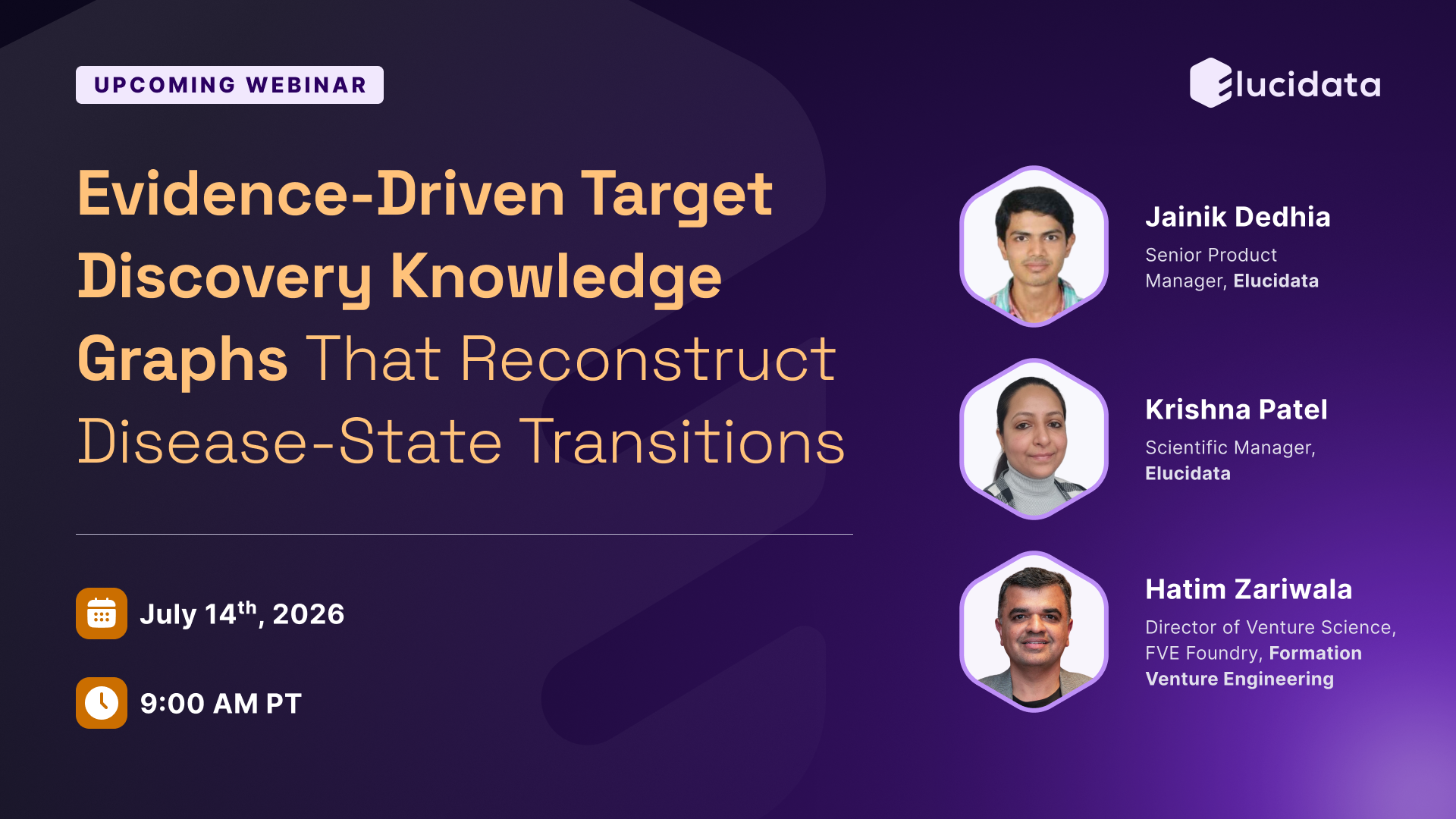

Any commodity knowledge graph or even a well prompted LLM can connect genes to diseases, drugs to targets, and targets to pathways. That's now table stakes - and it's not what moves a discovery program forward.
Real target discovery turns on mechanistic questions. In AML, the one that matters isn't which genes associate with the disease - it's what pushes a leukemic blast out of a self-renewing, differentiation-arrested state and onto a myeloid differentiation trajectory? Answering that takes directional, mechanistic evidence.
The evidence usually exists. The problem is that it's buried - in full-text methods sections, supplementary tables, experimental figures, and clinical readouts - and commodity graphs flatten it into undifferentiated associations, stripping out the directionality, evidence type, and biological context that make it decision-grade. Computational biology teams are left assembling that package by hand.
This webinar shows how our data infrastructure turns fragmented scientific data into queryable biological evidence through mechanistically rich knowledge graphs. Those graphs are now connected to LLMs via MCP servers - so the evidence is directly accessible from the AI tools your scientists already use. We'll work through it with AML as a running example and benchmark our approach against today's research assistants and literature-search workflows.


Any commodity knowledge graph or even a well prompted LLM can connect genes to diseases, drugs to targets, and targets to pathways. That's now table stakes - and it's not what moves a discovery program forward.
Real target discovery turns on mechanistic questions. In AML, the one that matters isn't which genes associate with the disease - it's what pushes a leukemic blast out of a self-renewing, differentiation-arrested state and onto a myeloid differentiation trajectory? Answering that takes directional, mechanistic evidence.
The evidence usually exists. The problem is that it's buried - in full-text methods sections, supplementary tables, experimental figures, and clinical readouts - and commodity graphs flatten it into undifferentiated associations, stripping out the directionality, evidence type, and biological context that make it decision-grade. Computational biology teams are left assembling that package by hand.
This webinar shows how our data infrastructure turns fragmented scientific data into queryable biological evidence through mechanistically rich knowledge graphs. Those graphs are now connected to LLMs via MCP servers - so the evidence is directly accessible from the AI tools your scientists already use. We'll work through it with AML as a running example and benchmark our approach against today's research assistants and literature-search workflows.
.webp)


.webp)
.webp)
Scaling clinico-genomic data integration: Large pharmaceutical organizations working with external data providers used Polly to build interoperable clinico-genomic data products 6x faster.
Although purchased datasets are often labeled as "clean," they still lack interoperability—Polly's pipelines bridge this gap with robust integration and harmonization.
Information Retrieval: Drug safety monitoring teams used Polly's Knowledge Graph powered co-scientist to conversationally retrieve the right cohorts & assess drug response—cutting discovery time by 70%.
%201.svg)


.png)
.png)
.png)

.png)


If you’re working with complex biological data, you may be asking:
Can generative AI truly assist in scientific reasoning, not just data analysis?
What does it mean for hypothesis generation, literature review, or even designing experiments?
Could this accelerate—not replace—my discovery pipeline?
Whether you're skeptical, curious, or already experimenting with AI in your lab—this is a session designed to ground your understanding in evidence, not speculation.
.png)


.svg)
.svg)


%201%20(1).svg)


.svg)
%20(3).webp)

.png)




.png)
.png)
.png)
.png)
.png)
.png)

.webp)

.webp)
.webp)
.webp)
.webp)
.webp)
.webp)
.webp)
.webp)
.webp)
.webp)
.webp)
.webp)


.svg)
%20(1).svg)


