.svg)
%201.svg)
AML Has Two Approved Menin Inhibitors. What Happens After the First Win?
%20(1).svg)

August 31, 2026
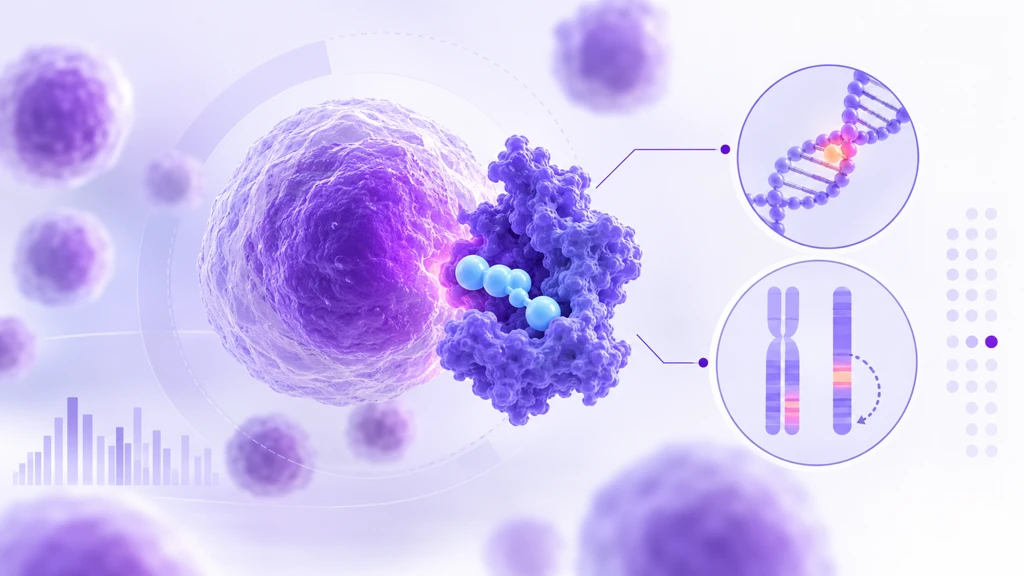
Some forms of acute myeloid leukemia (AML) are caused by well understood genetic mistakes. Two of the most common are called KMT2A rearrangements and NPM1 mutations. For years, doctors knew exactly what was going wrong in these patients but had no drug that could act on it directly. If a patient relapsed, the main options left were chemotherapy and a bone marrow transplant.
We recently explored the evolving landscape of AML treatment in the first article in our Target Discovery series, where menin inhibitors emerged as one of several therapeutic approaches.
That started to change with a new class of drugs called menin inhibitors. Menin is a protein inside cells. In these forms of AML, it acts like a switch stuck in the "on" position, keeping cancer cells locked in an immature, fast-growing state. Menin inhibitors block that switch.
Two drugs in this class are now approved, across three separate decisions:
Revumenib, approved in November 2024 for relapsed or refractory acute leukemia with a KMT2A translocation, then approved in October 2025 for relapsed or refractory AML with an NPM1 mutation, in patients aged 1 year and older.
Ziftomenib,approved weeks later, on November 13, 2025, as the first once-daily oral menin inhibitor cleared for relapsed or refractory AML with an NPM1 mutation. This approval covers adults only.
Having two different drugs, and one of them cleared for both genetic groups, is a real milestone. It also changes the questions researchers are asking.
The first question used to be simply: does blocking menin work? Now that the answer is yes, three new questions have taken its place. When in treatment should these drugs be used? Which patients beyond the original two genetic groups could benefit? And what happens when the cancer finds a way around the drug, since it usually does? Those three questions, plus a fourth one nobody was originally asking, are the next frontier for this drug class.
KMT2A rearrangements are relatively uncommon in adults, appearing in roughly 2 percent of newly diagnosed adult AML in one large single-center series, though they account for 15 to 20 percent of newly diagnosed adult AML. NPM1 mutations are far more common, showing up in roughly a third of adults with the disease. With revumenib now cleared for both, as much as 40 to 50 percent of the AML population falls within reach of a menin inhibitor.
Both mutations lead to the same underlying problem. A set of genes called HOXA9 and MEIS1 get switched on and stay on, and this keeps the leukemia cells from maturing into normal, functioning blood cells. Menin is the protein that holds this switched-on signal in place. Remove menin from the equation, and the cells that were stuck finally start to mature and die off the way they are supposed to.
This is different from most cancer drugs, which work by attacking a broken enzyme directly. Menin inhibitors instead remove a support structure, and because that support structure is shared across several genetically distinct types of leukemia, researchers believe the same drug class could eventually help a much larger share of AML patients, not just the two groups it was first approved for.
The two approved drugs are not interchangeable, and the difference shows up on the label. Both carry a boxed warning for differentiation syndrome, a potentially fatal reaction that can occur as the leukemia cells begin to mature. The difference is heart-rhythm risk. Revumenib's boxed warning also covers QTc prolongation and Torsades de Pointes, and its label calls for an ECG before treatment starts, weekly for the first 4 weeks, and monthly thereafter. Ziftomenib's approval carried no boxed warning on that front. QTc prolongation appears instead as a warning and precaution. That distinction is real, and it is one of the factors doctors weigh when choosing between the two for a given patient.
Two approvals settled the question of whether blocking menin works. Four other questions are now shaping where the field goes next.
A widening drug class: Additional menin inhibitors, including enzomenib, bleximenib, icovamenib, and BN104, are now in trials, with early data suggesting meaningful activity at different stages of development. The field may be heading toward the kind of multi-drug landscape already seen in chronic myeloid leukemia, where doctors choose between options based on a patient's health and tolerance rather than reaching for one default drug. As the resistance data below shows, that choice may soon depend on genetics as much as tolerance.
Moving earlier in treatment. These drugs are increasingly being tested at diagnosis instead of only after relapse. In the KOMET-007 trial, ziftomenib combined with standard induction chemotherapy produced composite complete response rates of 96 percent in NPM1-mutated AML and 90 percent in KMT2A-rearranged AML as of a January 16, 2026 data cutoff, with measurable residual disease negativity in 83 percent and 82 percent of responders respectively. Several randomized Phase 3 programs are now running in newly diagnosed patients, including KOMET-017 for ziftomenib across both intensive and non-intensive backbones, REVEAL-ND and EVOLVE-2 for revumenib, and HOVON 181 and cAMeLot-2 for bleximenib. Several use measurable residual disease endpoints designed to support accelerated approval, so a regulatory decision could arrive well before mature survival data does. Some early claims from press releases and conference abstracts are still running ahead of peer-reviewed publication.
The cancer is learning to resist. In a meaningful share of patients, the leukemia acquires a new mutation in the menin gene itself, letting the cancer escape the drug's effect. In the original series, MEN1 mutations were absent before treatment but present in 12 of 31 patients after at least two cycles of revumenib. The timing varies widely. Documented cases include a resistant clone emerging at the start of cycle 4 in a patient with stable disease, and another appearing at cycle 11 in a patient who had been in measurable residual disease negative remission since cycle 8. Critically, these mutations are not equally disabling across the class. Some MEN1 variants block one drug while leaving another still able to bind, and one patient who relapsed on revumenib with an M327I mutation went on to achieve a measurable residual disease negative remission after switching to bleximenib. Finding these mutations has historically required an invasive bone marrow biopsy, but emerging liquid biopsy work suggests they may be caught earlier through a simple blood draw. In one reported case, plasma cell-free DNA detected an emerging resistance mutation at the start of cycle 4 while same-day marrow sequencing found nothing, and overt progression followed by the end of that cycle. In a second case, the resistant clone showed up in plasma roughly three cycles before marrow-confirmed relapse.
A second, unexpected job. Menin inhibition also appears to switch on dormant viral sequences buried in a cell's own DNA, a phenomenon called viral mimicry, which triggers an interferon response and raises MHC-II levels, making leukemia cells more visible to the immune system. The most interesting part of that finding speaks directly to the patient-expansion question above: some AML cells with neither a KMT2A rearrangement nor an NPM1 mutation also raised MHC-II levels under menin inhibition, which hints at a use for these drugs in patients well outside the two approved groups. Related preclinical work suggests menin inhibition induces consistent expression of the surface marker CLEC12A, which could make CLEC12A-directed CAR-T approaches more effective. That last finding is a conference abstract rather than a full peer-reviewed paper, and this whole frontier is preclinical and earlier stage than the approval data above.
None of these four frontiers were obvious from the original mechanism alone. Each one only came into view because researchers kept checking the same biology against new evidence: drug safety profiles across a growing list of chemical compounds, remission data across dozens of trial arms, resistance mutations turning up in blood samples, and gene activity nobody thought to look for until an unrelated lab screen stumbled onto it.
That is the broader lesson menin inhibitors offer. A validated drug target rarely stays simple. The next real advance usually comes from connecting evidence that started out scattered across different trials, different labs, and different fields of study.
Each of the four frontiers above is really an evidence-linking problem. Comparing enzomenib, bleximenib, icovamenib, and BN104 against revumenib and ziftomenib means tracking safety and response data across trials that were never designed to be read side by side. Deciding whether frontline treatment should become the new standard depends on reading multiple ongoing Phase 3 trials as one unfolding picture rather than as separate, disconnected readouts. Choosing a second drug after resistance means connecting a specific mutation found in a blood draw to structural binding data generated for a different compound in a different lab. And the viral mimicry hypothesis only became visible because someone checked immunology data against a target that had already been mapped for its role in transcription.
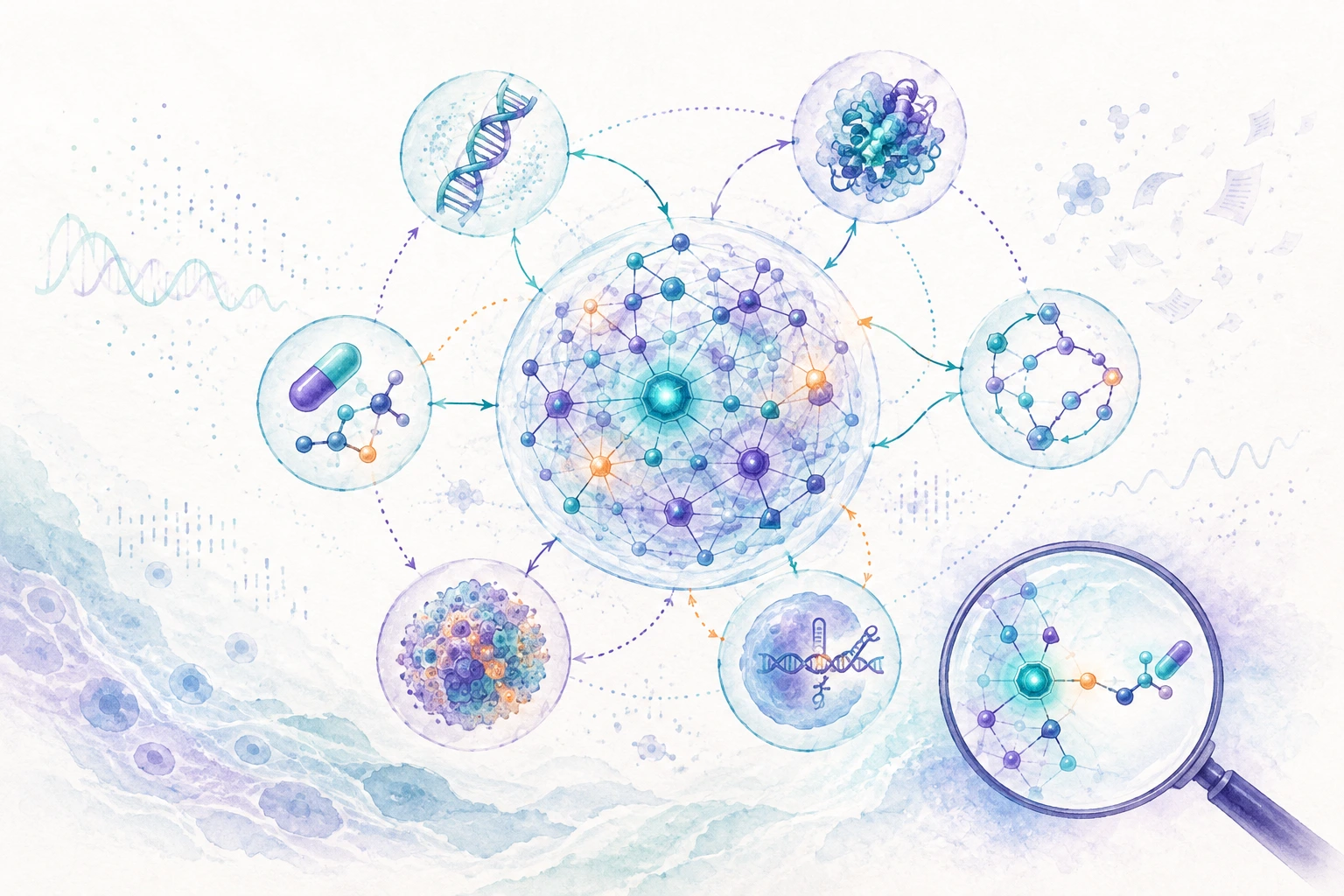
We recently ran a webinar on exactly this kind of evidence reconstruction in AML: how gene-disease relations can be pulled together into a knowledge graph that can be queried across complex biological questions.
This is the kind of connective work Elucidata's Polly Knowledge Graph is built to support: a mechanistically typed map of targets, genes, and pathways that makes it possible to trace a single biological thread.


.svg)
.svg)


%201%20(1).svg)


%201%20(1).svg)





%20(1).svg)






.svg)
%20(1).svg)


