.svg)
%201.svg)
Elucidata x Wiley: Full-Text Access Surfaces More Fibrillation Pathway and Synaptic Plasticity Connections in Alzheimer's Disease
%20(1).svg)

September 16, 2026
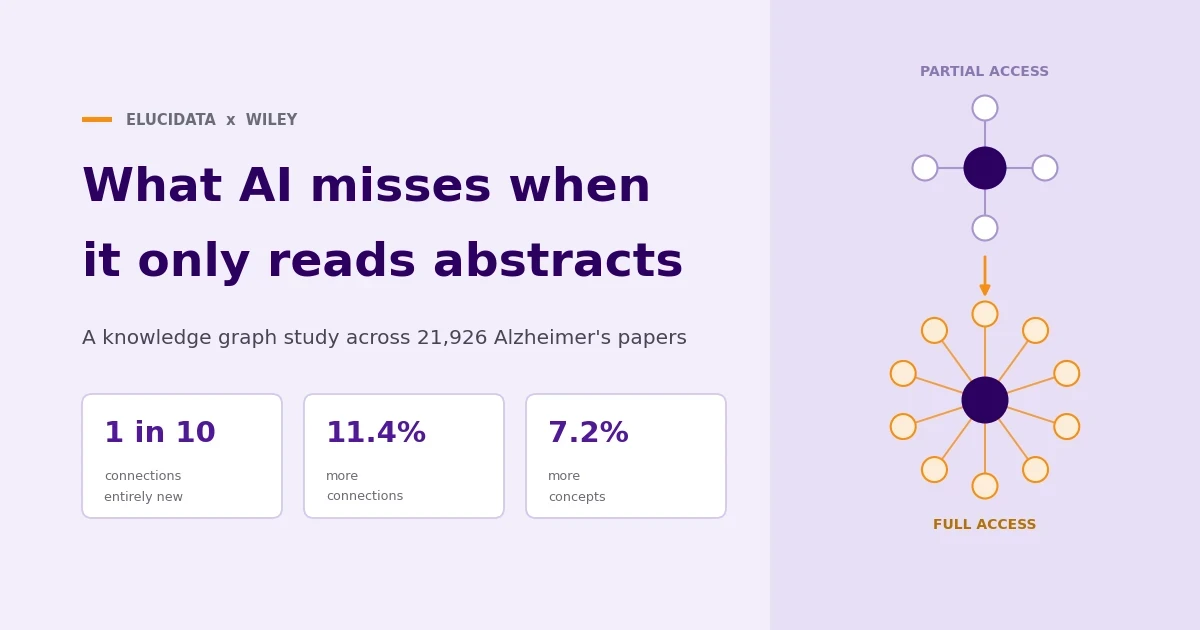
In a Nutshell: We built two knowledge graphs from the same 21,926 Alzheimer's disease articles, changing only whether the paywalled subset could be read as abstracts or in full. Overall coverage barely moved, yet two nodes changed the outcomes completely. The fibrillation pathway turned from a mechanistic dead end into a hub linking Alzheimer's to Parkinson's, Huntington's, and systemic amyloidosis, while the amyloid beta relationship with synaptic plasticity gained substantially more supporting detail without gaining a single new concept. None of it was new to science, it was just sitting in discussion sections, where abstracts only knowledge graphs cannot reach.
Most biomedical AI systems read abstracts rather than full articles. This happens less by design than by availability, since open repositories index abstracts comprehensively and full text only selectively. The corpus that ends up inside a retrieval index or a graph is therefore weighted heavily toward summaries, and the working assumption is that this weighting is acceptable because an abstract states the finding while the body merely supplies supporting detail.
Any relationship consequential enough to redirect a research program would have earned its place in the summary already.
We wanted to know whether that assumption holds up under measurement. Working with Wiley, we built two knowledge graphs from article sets that were identical except for how deeply each one could be read, then compared what each graph knew. Four questions shaped the study:
The result was not the uniform increase in density we expected. A small number of nodes had their entire role in the graph rewritten. The fibrillation pathway went from a mechanistic dead end to a hub linking four proteinopathies, and the relationship between amyloid beta and synaptic plasticity gained a third more supporting connections without gaining a single new concept. Both findings sat entirely in the paywalled full text.
Alzheimer's disease was chosen for two reasons that reinforce each other: The literature is large and expanding rapidly, and the underlying mechanisms remain genuinely unsettled rather than merely undocumented. If the depth of access changes the shape of a knowledge graph anywhere, it needs to be most visible in a field where the biology is still being actively questioned. We took the help of Wiley as they hold paywalled articles of this subject.
We assembled 21,926 articles and divided them into two cohorts that share an identical base of 13,801 open-access articles drawn from OpenAlex across all publishers and ingested as full text. On top of that shared base, Cohort A received 8,125 Wiley articles represented by their abstracts alone, while Cohort B received the same 8,125 Wiley articles in full text.
Because the article count, the open-access baseline, and the publication set are all identical across the two arms, the only variable that differs is depth of access on the Wiley subset. This means that any difference between the resulting graphs can be attributed to what is beyond the abstract.
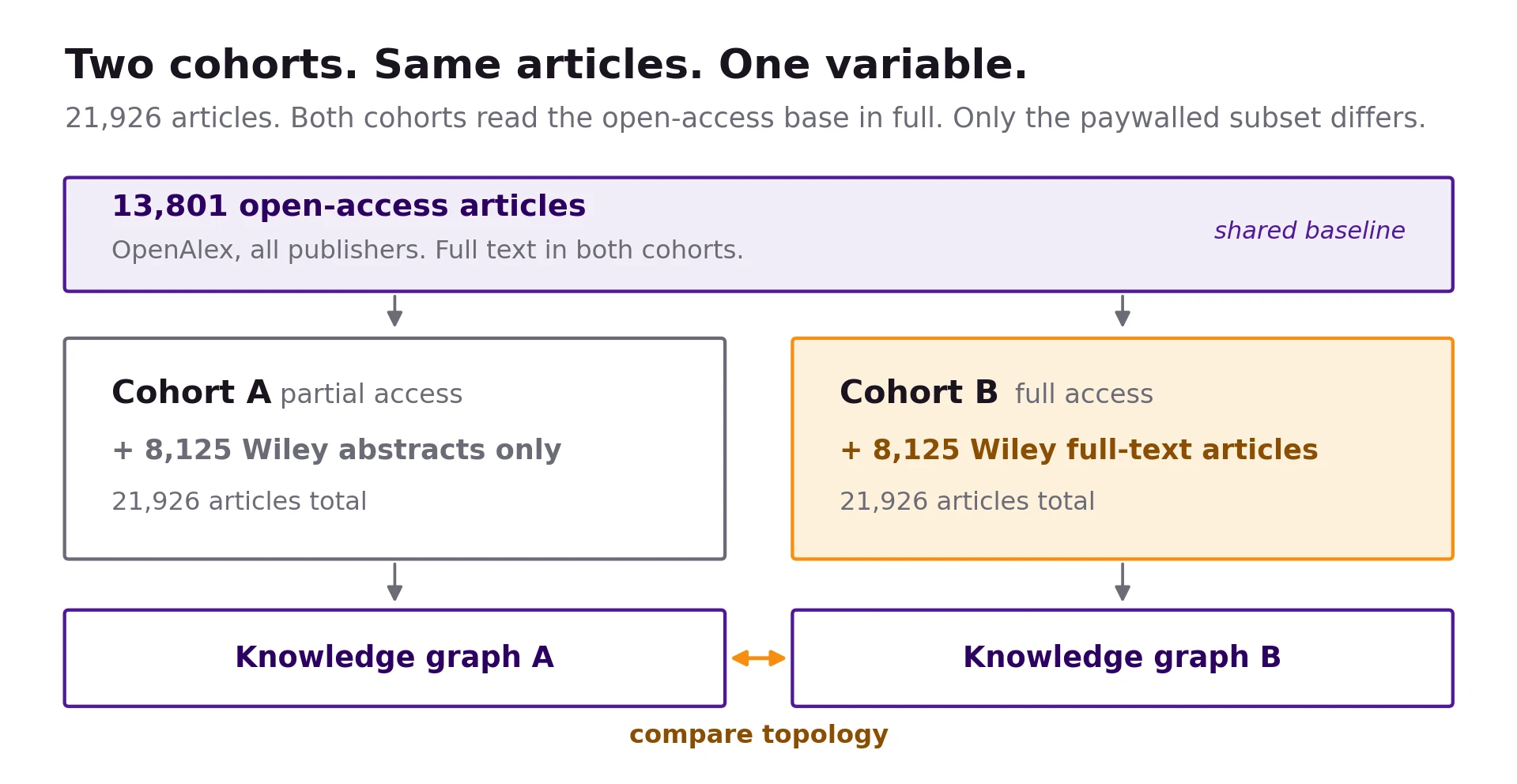
Both cohorts passed through the same pipeline. LLM-based named entity recognition extracted the three entity classes most relevant to target prioritization: genes and proteins, diseases, and pathways. Relation extraction produced directed, typed triplets of the form “MAPT inhibits APOPTOTIC PROCESS” or “BACE1 activates AMYLOID PRECURSOR PROTEIN”. A harmonization step then normalized surface forms to canonical entities, collapsed redundancy, and assembled the surviving triplets into a directed graph.
We measured three quantities across the resulting pair of graphs:
The first two are volume metrics and the third is what carries the structural argument, because a change in an entity's neighbourhood is a change in what the graph can be traversed to reach from that entity.
One caveat on PageRank is worth stating, since it constrains what we claim. PageRank is a probability distribution summing to one across a graph, so values are not directly comparable between two graphs of different sizes. Cohort B holds more entities, which lowers the mean PageRank per node by construction. We therefore use PageRank to read relative prominence within each graph rather than as a cross-cohort delta, and the findings below rest on neighbourhood comparison.
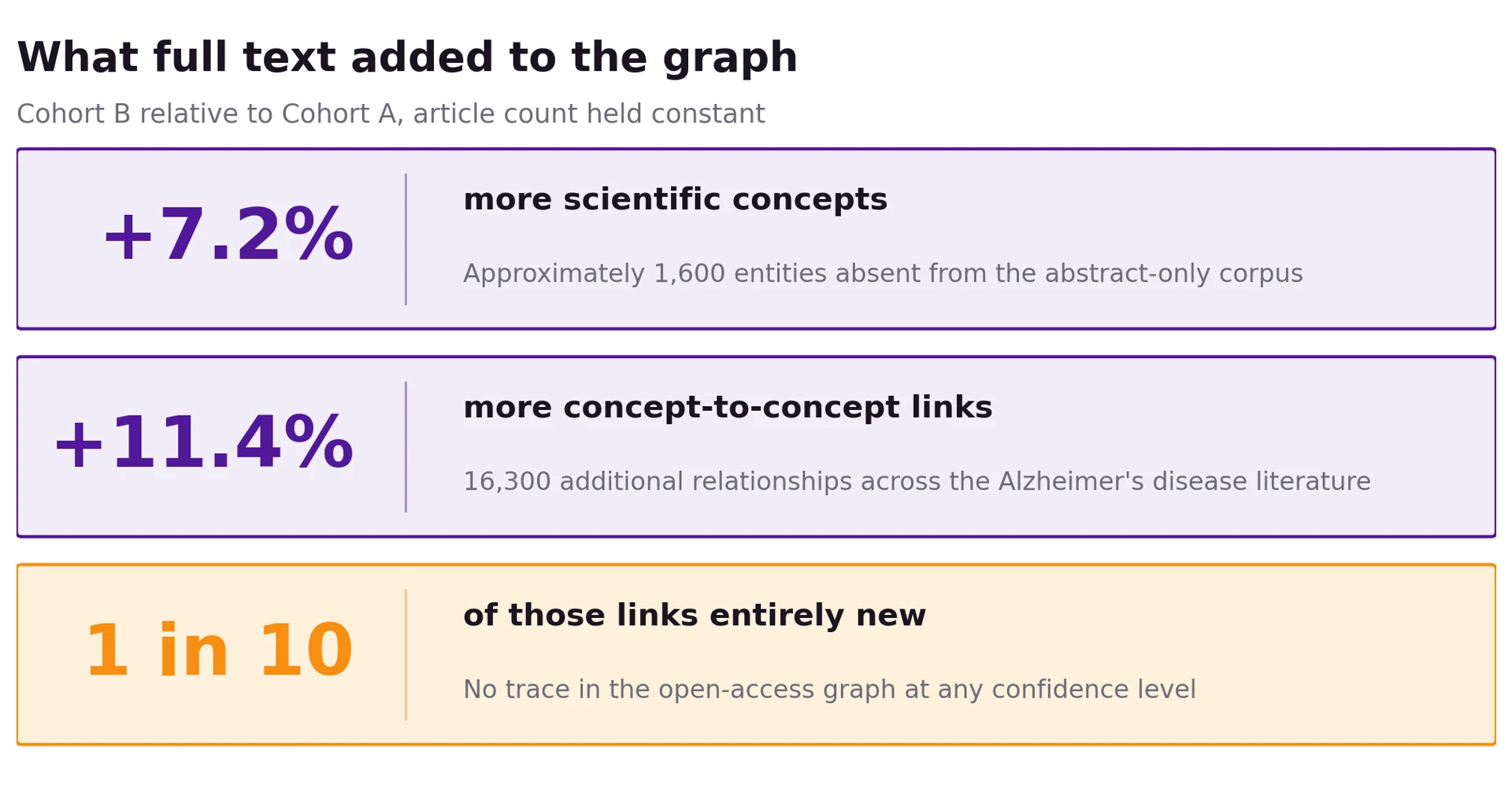
Cohort B contains 7.2% more distinct scientific concepts, amounting to roughly 1,600 entities with no representation whatsoever in the abstract-only corpus, and it contains 11.4% more concept-to-concept relationships, which translates to an additional 16,300 edges. Of those new edges, approximately 1 in 10 are entirely novel, meaning the relationship leaves no trace in the open-access graph at any confidence level.
Taken in isolation those percentages are an unremarkable result, since corpus enrichment of almost any kind tends to produce numbers in that range, and a sceptical reader would be right to shrug at them. The percentages mislead, however, because the uplift is not distributed evenly across the graph. Full text does not thicken the network uniformly but concentrates on particular nodes, and on those nodes the change is transformative rather than incremental.
We extracted the 1-hop neighbourhood of the fibrillation pathway node from both graphs and compared them directly.
In the partial-access cohort, the node carries 5 neighbours and 44 edges. It connects to amyloid precursor protein, alpha-synuclein, bovine insulin, and amyloid fibrils, forming a recognizable but thin picture of fibrillation as a biophysical process characterized through standard in vitro aggregation models.
In the full-text cohort, the same node carries 11 neighbours and 161 edges.
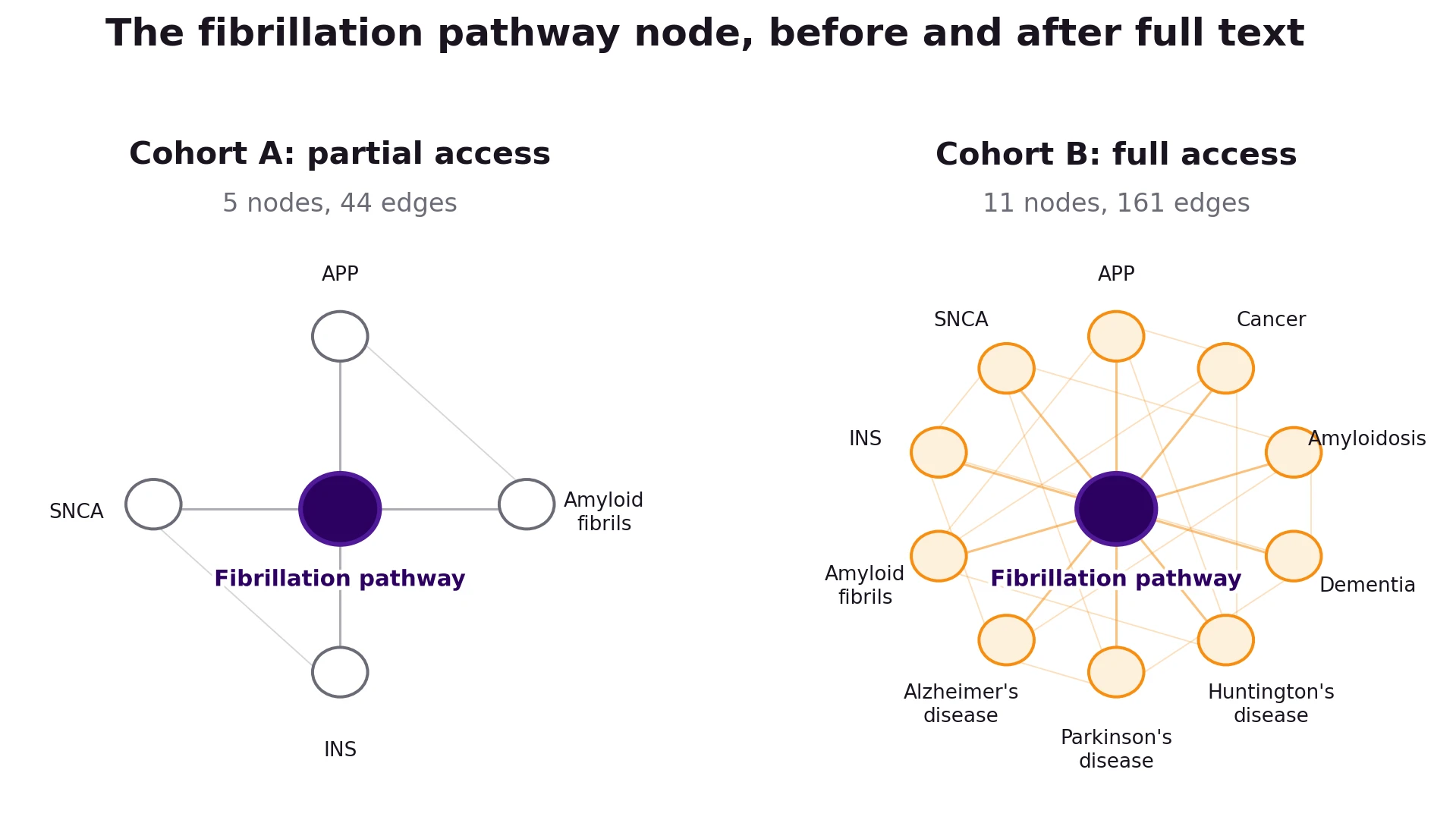
The significance is not the edge count. It is what the edge count does to the node's function.
In Cohort A, fibrillation behaves as a mechanistic leaf attached to four proteins, the kind of node a traversal algorithm passes through on its way somewhere more promising.
In Cohort B, the same node operates as a hub connecting four distinct proteinopathies alongside a systemic amyloid disorder, sitting directly on the shortest path from Alzheimer's disease to Parkinson's disease and from Alzheimer's disease to Huntington's disease.
Same pathway. Same literature. Structurally different object.
Consider a target that modifies protein aggregation.
Evaluated against Cohort A, it reads as narrowly Alzheimer's-specific. A single-indication bet, priced accordingly.
Evaluated against Cohort B, the same target carries visible cross-indication optionality and, equally important, visible shared-mechanism risk, because a mechanism common to four diseases can fail across four diseases. Neither of those is a footnote. They are the substance of the case taken to a governance committee or a partner.
One graph supports that conversation. The other does not, and gives no signal that anything is absent.
The reason those edges hide is worth naming. An abstract reports what a study found. The observation that aggregation kinetics resemble those reported in synucleinopathy, or that the same chaperone system keeps appearing in polyglutamine disease, belongs in the discussion section. Discussion sections are where researchers do their comparative thinking, and comparative thinking is what a cross-indication rationale is built from.
An abstract-only pipeline reads the findings of a field and discards its reasoning.
The amyloid beta node shows the same effect in a different form.
Its 1-hop neighbourhood holds 75 nodes in both cohorts. Identical. But the partial-access graph supports 1,421 edges between them against 1,885 in the full-access graph, with the union reaching 85 nodes and 1,961 edges. The entity set barely shifts while the edge set moves by roughly a third.
In our comparison, the enrichment concentrated on the relationship between amyloid beta and long-term synaptic potentiation, alongside macroautophagy, inflammatory response, and apoptotic process. The underlying biology here is not in dispute, and has been documented for over two decades: soluble amyloid beta oligomers inhibit hippocampal long-term potentiation in vivo [1], and dimers isolated directly from Alzheimer's brain tissue impair synaptic plasticity and memory [2]. What differed between our two cohorts was not whether that relationship is known to science, but how much of its mechanistic detail either graph could represent. Both graphs record that amyloid beta and synaptic function are related. Only one records through which intermediates and under what conditions.
This is the quieter failure mode, and arguably the worse one. Nothing is missing at the entity level, so a coverage audit passes without flagging anything. What goes missing is resolution on precisely the relationship a synaptic-function strategy would be built on.
Strip away the Alzheimer's specifics and a pattern remains that applies to any program built on a mechanism that crosses therapeutic areas.
Cross-disease mechanistic observations are systematically underrepresented in abstracts. That is not a quirk of neurodegeneration literature. It follows from how papers are written, since an abstract carries the primary finding of one study in one indication, while the comparative reasoning that connects it to a second indication sits in the discussion.
Any program whose thesis depends on that comparative reasoning is therefore reading from a map with predictable holes in it.
Complement pathway biology is a useful illustration of the class. Complement dysregulation runs through geographic atrophy in the eye, C3 glomerulopathy and IgA nephropathy in the kidney, and paroxysmal nocturnal hemoglobinuria in blood, and the therapeutic history reflects it. Iptacopan now carries approvals across paroxysmal nocturnal hemoglobinuria, C3 glomerulopathy, and IgA nephropathy, while pegcetacoplan is approved in paroxysmal nocturnal hemoglobinuria, geographic atrophy, and C3 glomerulopathy [3]. A team asking which additional indications a complement-directed asset should be evaluated against is asking exactly the question the fibrillation node answered here. The evidence supporting it sits disproportionately in discussion sections.
The same shape applies to inflammasome biology across dermatology and neurology, to integrated stress response across oncology and neurodegeneration, and to fibrosis mechanisms across lung, liver, and kidney. Wherever a mechanism has a home therapeutic area and a set of adjacent ones, the edges connecting them are the ones a partial-access pipeline drops.
The design is portable. It requires a disease, a pathway whose home sits in another therapeutic area, and access to the literature at both depths.
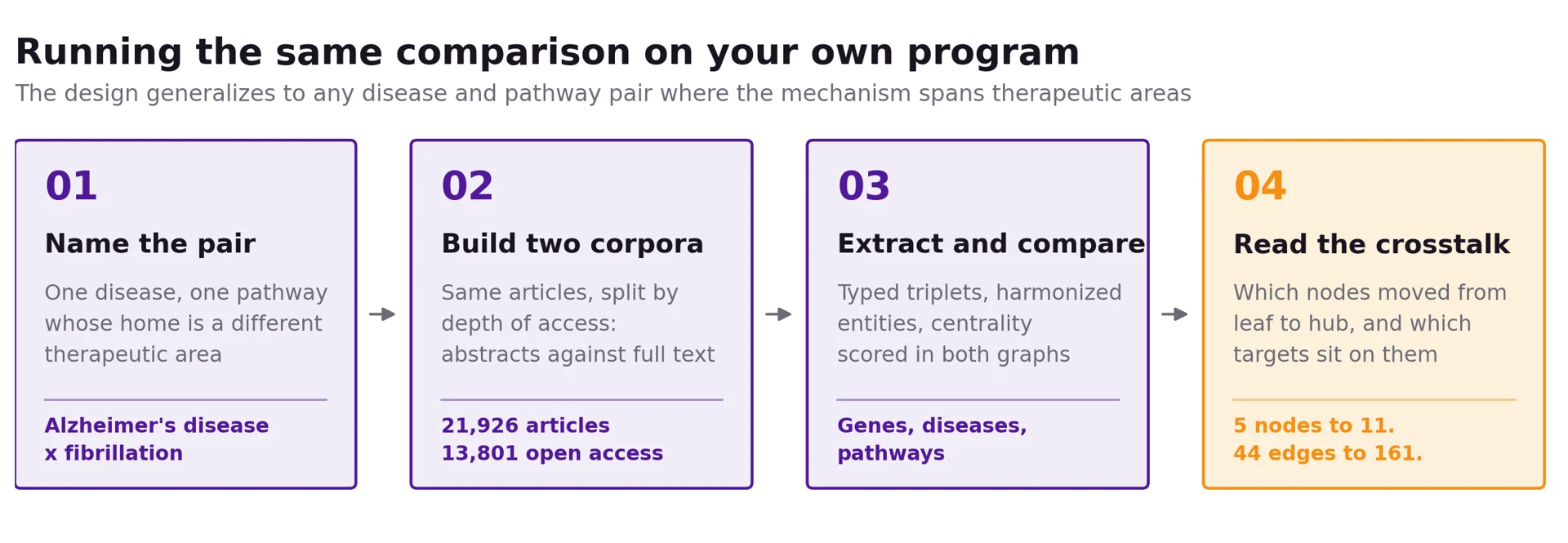
What you define: The disease and pathway pair, the indications worth testing for crosstalk, and the entity types that matter to your decision. We restricted this pilot to genes, diseases, and pathways, but small molecules, cell types, biomarkers, and phenotypes are all extractable when the question needs them.
What gets built: Two graphs from a matched corpus, differing only in depth of access, so the comparison isolates what content depth contributes rather than confounding it with corpus size.
What comes back: A ranked account of which nodes shifted from periphery to centre, which relationships appear only in full text, and which targets sit on the newly connected paths. Provenance tags back to source, so any claim can be traced to the article that supports it.
What it takes: This ran in five days at pilot scale. A program-specific build with wider entity coverage, weighted relations, and human-in-the-loop quality control is a longer engagement, and the pilot is usually the right way to establish whether the signal justifies it.
The word fibrillation carries two unrelated meanings in biomedical literature. It describes both the aggregation of proteins into insoluble fibrils and the irregular cardiac electrical activity that characterizes atrial fibrillation, and automated entity recognition can collapse the two whenever they share a surface form.
In this graph the node resolves unambiguously to protein fibrillation. The neighbourhood settles it, comprising amyloid fibrils, alpha-synuclein, amyloid precursor protein, and bovine insulin, the last being a standard in vitro aggregation model. No cardiac entity appears anywhere in it, and a genuine atrial fibrillation node would be expected to recruit stroke, anticoagulation, heart failure, or canonical arrhythmia loci such as PITX2 and ZFHX3.
The distinction matters beyond bookkeeping. A real epidemiological and genetic literature does connect atrial fibrillation to dementia risk, and that is a separate line of enquiry from the cross-proteinopathy mechanism described here. Conflating them would attribute a cardiovascular comorbidity finding to a graph that never contained one.
Any team running a comparable analysis should verify ambiguous nodes against their neighbourhood before building on them. Grounding belongs inside the pipeline rather than in a review meeting.
The failure mode at work here is not hallucination, since an abstract-only system produces relationships that are real, sourced, and fully traceable. It simply produces fewer of them, and the ones it omits are systematically the cross-domain relationships rather than a random sample.
That systematic quality is what makes the sparsity consequential, because random sparsity degrades every hypothesis roughly equally and the resulting ranking tends to survive, whereas structured sparsity suppresses precisely the multi-hop and cross-indication reasoning chains that separate a defensible target rationale from a merely plausible one. It does so, moreover, without leaving any signal that something is absent.
A CSO deciding which 2 of 20 candidate targets should advance to validation is not asking what exists in the literature, but rather which evidence trail will hold up under scrutiny from a board or a prospective partner. Answering that question requires reasoning across disease boundaries, and the edges that make such reasoning possible sit disproportionately behind the abstract.
This ran as a pilot, and the constraints deserve to be mentioned:
Two directions, and they answer different questions. The first makes the graph itself better. The second is about what you build on top of it once it is.
The comparison in this study was diagnostic. It measured what full text adds. The same graph, once built, is infrastructure for several things that matter more than the measurement.
GraphRAG for evidence-grounded retrieval: Conventional retrieval-augmented generation fetches passages by semantic similarity, which means it retrieves text that reads like the question rather than evidence that bears on it. Grounding retrieval in a typed graph changes what comes back: a question about a target's cross-indication rationale can traverse actual mechanistic relationships and return the specific edges supporting each hop, with provenance attached. The fibrillation result is a direct argument for this, since a similarity-based retriever over abstracts would never have surfaced those six disease links, because the text stating them was never in the index.
Edge prediction for hypothesis generation: A graph with enough typed structure supports asking which relationships should exist given the topology but have not yet been reported. Link prediction over a biomedical knowledge graph is a well-established approach to target and indication discovery, and its output quality depends entirely on how complete the training topology is. That is the connection back to this study: a model trained on the partial-access graph would be learning from a topology missing 1 in 10 of its cross-domain edges, and would therefore predict conservatively toward relationships the literature already states plainly.
Contradiction and consistency checking: Typed, provenance-tagged edges make it possible to surface where sources disagree, rather than silently collapsing a contested relationship into a single asserted fact. For a mechanism under active debate, knowing that the evidence is split is more useful than a confident edge.
Portfolio and competitive mapping: Once clinical evidence sits alongside mechanistic evidence in the same structure, questions about which competitors are pursuing a shared mechanism, and in which indications, become traversals rather than manual literature reviews.
Each of these inherits the completeness of the graph underneath it. That is the practical reason the measurement in this study matters. An incomplete graph does not announce itself as incomplete, and every application built on top of it inherits the gap silently.
The conclusion travels well beyond Alzheimer's disease. Wherever mechanisms are complex and literature is dense, the connective tissue of a field lives past the abstract. A system that cannot reach it will keep producing work that is coherent, well-sourced, and quietly incomplete, which is a harder problem to catch than being wrong.
Elucidata builds the harmonization and graph infrastructure that makes measurement of this kind possible, and Polly Knowledge Graph is where these mechanistic layers are assembled and queried. If you are working on a mechanism that spans therapeutic areas and want to know what your current evidence base is missing, we would be glad to scope the same comparison against your program.
Key Takeaway: A controlled comparison across 21,926 Alzheimer's research articles shows that the connections biomedical AI systems miss are not randomly distributed. The fibrillation pathway node gained 117 edges and six disease neighbours the moment the full text became readable, and the amyloid beta link to synaptic plasticity gained a third more edge. Cross-disease mechanistic evidence is systematically the evidence that hides beyond abstracts, which makes it the evidence any cross-indication thesis most depends on.
Every figure describing the two graphs is a primary result of this study rather than a literature claim: the entity and relationship counts, the 1-hop neighbourhood comparisons, and the edge attributions. Those are not citable to external work, because no external work ran this comparison. Each extracted relationship in both graphs carries provenance back to the source article, and the corpus is fully enumerable: 13,801 open-access articles resolved through OpenAlex and 8,125 Wiley articles, all identifiable by DOI. We can make the accession list and per-node neighbourhood exports available for review.
References below support the background biology and the contextual claims only:
Analysis conducted by Elucidata in partnership with Wiley, May 2026. Corpus: 21,926 Alzheimer's disease research articles.





.svg)
.svg)


%201%20(1).svg)


%201%20(1).svg)


%20(1).svg)




.svg)
%20(1).svg)


