
Polly KG slashes months off your timeline. Generate hypotheses 75% faster and pinpoint target IDs in six months.
%201%20(1).svg)


Unify diverse data, from genomics to clinical records, into a single, comprehensive graph.

Trust human-level accuracy, validated in benchmark studies (e.g., 4/5 drug identifications at P≤0.05).

Ensures global scientific alignment with 100% ontology mapping and rigorous data validation.
.svg)
Unify knowledge across over 50 species, extending insights beyond human-centric data.

Seamlessly optimize and integrate your existing, complex data pipelines.

One view to surface pathways, druggability, interactions, co-expression, trials, and your internal data.


Explore complex biological systems efficiently, without code or manual searches.

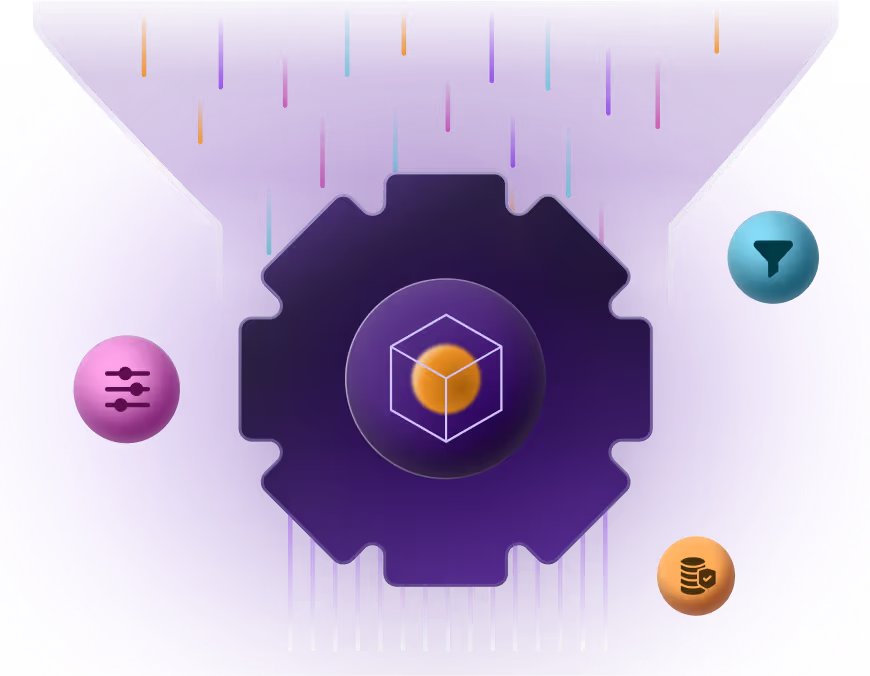
Get custom target scoring and linkage prediction for precise, multi-indication targeting.
Excels where traditional KGs fail, providing solutions for non-model organisms and limited data.
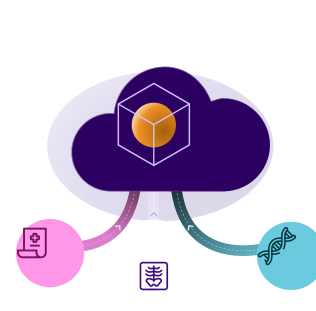

Achieve 75% faster hypothesis generation (months to hours), cutting target ID to just 6 months.


Get custom target scoring and linkage prediction for precise, multi-indication targeting.
Excels where traditional KGs fail, providing solutions for non-model organisms and limited data.

Achieve 75% faster hypothesis generation (months to hours), cutting target ID to just 6 months.
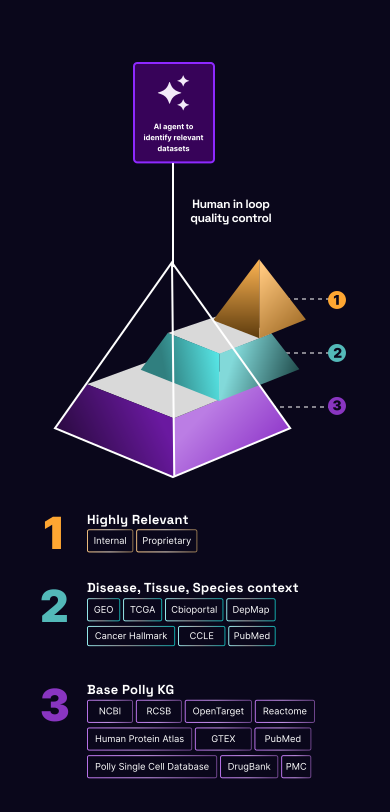
Our unique, multi-layered architecture ensures you always have the most relevant, secure, and up-to-date information.

Broad, regularly updated public knowledge.

Securely integrates your sensitive internal data.

Tailored and frequently refreshed for specific use cases.
Polly KG is built for the future of biology, designed to evolve with your research needs

Built on millions of nodes and relationships, integrating 20+ sources, including the largest single-cell data collection.

Unify knowledge across over 50 species, extending insights beyond human-centric data.
.webp)




.webp)

.webp)


.webp)

.webp)



Despite the availability of multi-omics data, research workflows are often constrained by fragmentation, inconsistent data standards, and limited biological context. These challenges significantly slow hypothesis generation and validation.
Elucidata’s Polly Knowledge Graph addresses this by harmonizing and contextualizing multi-modal datasets into a unified framework, enabling faster and more reliable target discovery.
Multi-omics datasets are inherently complex and difficult to interpret without structured context. Traditional approaches often fail to capture relationships across data types.
Polly KG applies a data-centric AI approach, organizing data into biologically meaningful relationships that support evidence-based decision-making and deeper insight generation.
Conventional data integration pipelines often lead to loss of biological relationships and context.
A knowledge graph-based approach, such as Polly KG, enables context-aware integration, preserving connections across genes, pathways, diseases, and experimental conditions within a unified structure.
False positives frequently arise from poor data quality, lack of contextual validation, and fragmented analysis pipelines.
Polly KG delivers scientifically grounded, evidence-backed insights, ensuring that identified targets are supported by curated datasets and biologically relevant relationships.
Scaling research workflows typically introduces additional data silos and inefficiencies.
Polly KG is built as a customization-first platform (PaaS), allowing organizations to adapt data models and workflows to their specific needs while maintaining scalability, consistency, and operational efficiency.
Disconnected datasets limit the ability to generate holistic biological insights.
Polly KG leverages a three-layered architecture-data, context, and insight layers-to connect and contextualize information across experiments, enabling comprehensive exploration of biological relationships.
Indication expansion requires integrating signals across diverse datasets, including disease biology, pathways, and molecular interactions.
Polly KG enables systematic exploration of these relationships, supporting the identification of novel indications through a unified and context-rich data model.
Inconsistent data processing and lack of standardization often lead to irreproducible results.
Polly KG provides harmonized, ML-ready datasets and standardized analytical frameworks, ensuring consistent, reproducible outcomes across teams and studies.
The effectiveness of AI models is highly dependent on data quality and structure.
Polly KG adopts a data-centric AI paradigm, ensuring that models are trained on high-quality, well-annotated, and contextually enriched datasets, resulting in more reliable and interpretable outputs.
Biomarkers enable early disease detection, improve patient stratification, and guide treatment decisions. In areas like oncology, immunology, and CNS diseases, they play a critical role in advancing precision medicine and improving patient outcomes.
An effective knowledge graph platform should support multi-modal data integration, contextual modeling of biological relationships, scalability, and seamless workflow integration.
Elucidata’s Knowledge Graph offering combines these capabilities into a purpose-built solution for biopharma R&D, enabling end-to-end knowledge discovery with scientific rigor and operational efficiency.
.svg)

.svg)


.svg)
%201%20(1).svg)
%20(1).svg)
%201%20(1).svg)
.svg)
%201.svg)
.svg)


%201%20(4).svg)
%201%20(3).svg)