
I’m Abhishek Jha, a dad, husband, and scientist turned entrepreneur.
In this newsletter, I want to share a few lessons from the field: observations from nearly a decade of building, learning, and stumbling forward.
If you’re a scientist thinking about starting up or already straddling that blurry line between research and entrepreneurship, I hope this gives you something to reflect on.
This month my son learned how to bike, he lost his first tooth and my 10 month old daughter stood up for the first time!
Significant milestones for us as a family and personally as a father.
As luck would have it, I was the only person in a family of four not to be there in person for any of these moments.
Why am I sharing this in a monologue with you?
Many reasons, actually. Well for one, this is a personal newsletter and as a person I think and care things other than data quality as well! Who would have thought?
The second reason: just like that it would be close to 10 years since I started on the journey of entrepreneurship while having trained to be a scientist for most of my adult life.
And just like that it feels like I have learned a thing or two along the way.
I have been rather surprised by the response when I am chatting with younger, newer scientists and engineers who have embarked upon the entrepreneurship journey.
So this news letter is a few lessons from the field as a scientist turned entrepreneur. The usual caveat holds.I don't have all the answers but I have some observations which may or may not resonate with you. Every enterpreneur is on their unique journey and if you nod in agreement while you read this I would consider this a success.If you disagree I would love to hear your thoughts. If you are on the fence and contemplating a jump I hope this letter helps. In any case, I would love to hear from you.
In the earliest days, you don’t have much to base a decision on. No amount of sensitivity analysis can de-risk the leap.
Chances are, you’ll work twice as much, get paid half (if you're lucky), and everything you planned in January will look different by August.
You might have a clear career path ahead—VP at a pharma giant, equity at a Series D biotech, or tenure within reach.
But if deep inside you feel this is the moment for you, if this is the idea that won’t leave you alone, then you owe it to yourself to follow it.
My own decision to start up was less about spreadsheets and more about an instinct.
An instinct that was based in hindsight on a vague vision that has evolved over the last decade.
For better or worse, I did not overanalyze it. On day one, naivety helped.
So did having a supportive spouse and a co-founder willing to go the distance.
The rest I’m figuring out—piece by piece, quarter by quarter.
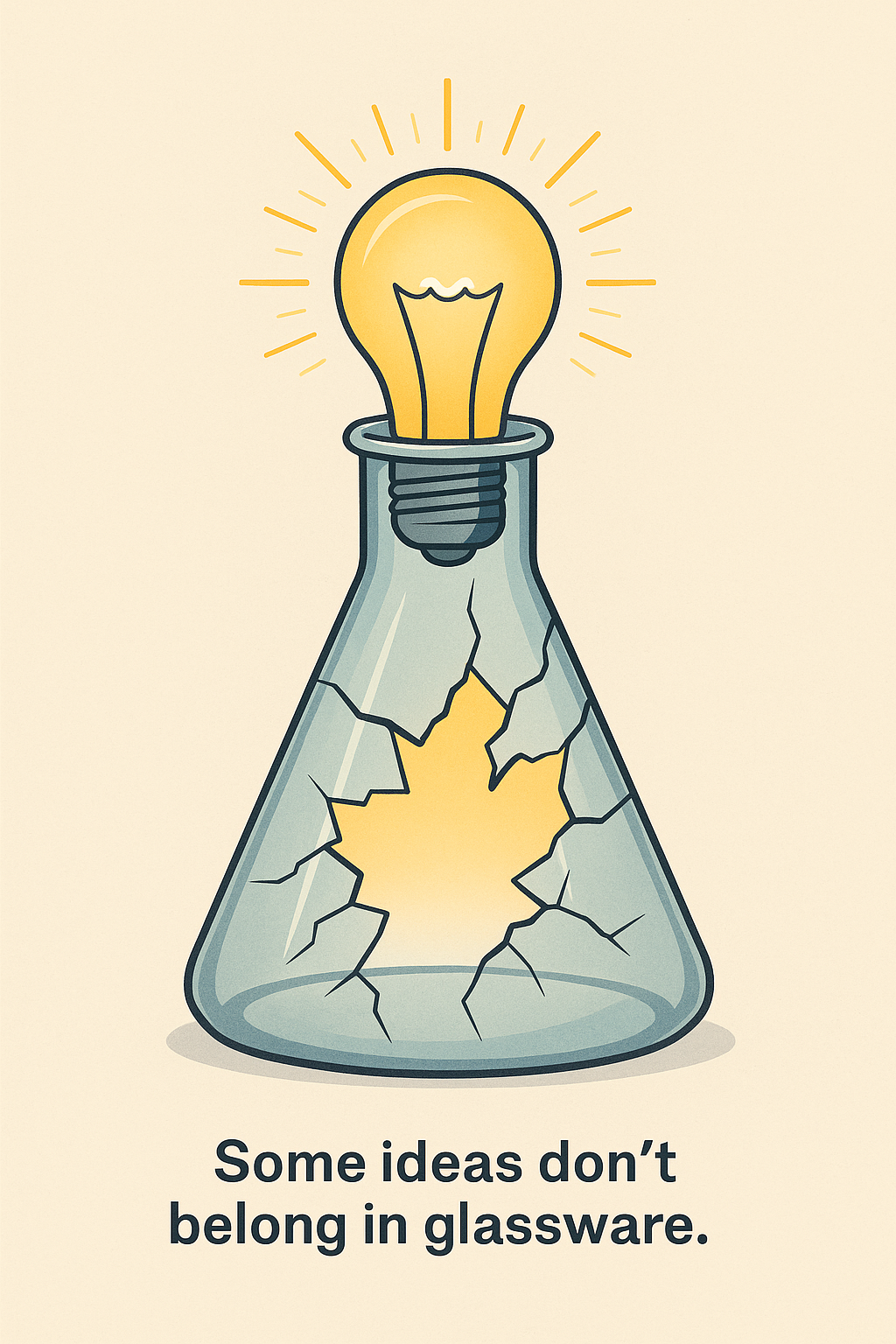
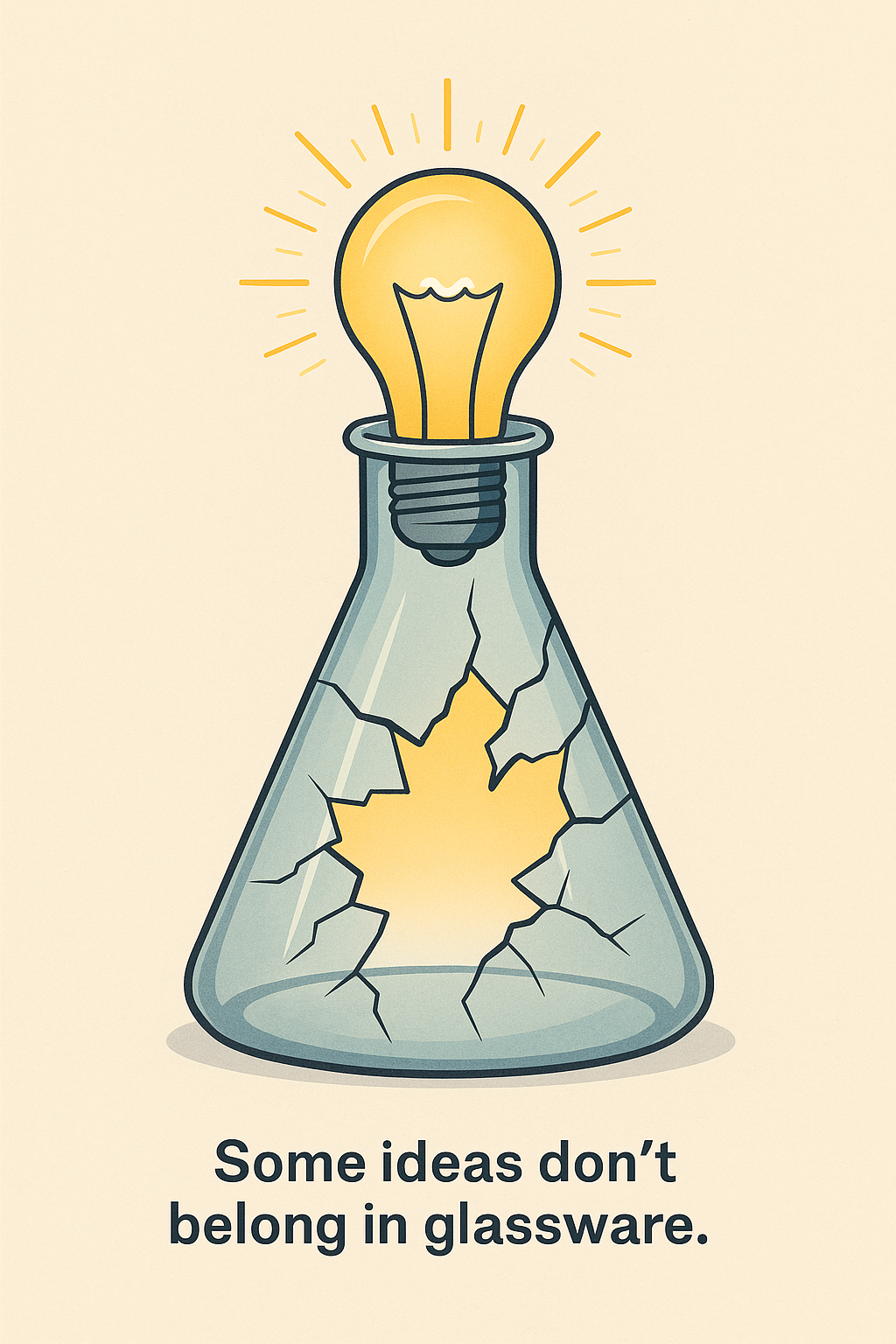
It turns out, some of the most valuable tools from your academic training transfer quite well into the startup world.
Hypothesize-Test- Analyze- Refine- Repeat.
But unlike science, startups don't give you clean baselines or well-controlled variables.
You’re running experiments in the wild—customer behavior, market timing, hiring decisions—all of it entangled and noisy.
Still, the scientific method helps.
What feels like chaos is actually data-rich environment—if you know how to listen.
You’ll test hypotheses about your product, your market, your distribution. And more often than not, you’ll be wrong.
That doesn’t mean you failed. It means the model was incomplete.
Just like in research, the job is to update your model—not your mission.
The trick is learning when to double down on a promising result versus when you're chasing artifacts.
When to zoom in and measure, and when to step back and recalibrate the entire experiment.
Startups reward that kind of thinking. Iterative, grounded, and falsifiable.
It’s not about being right from the start. It’s about having the right process to converge on something that works.
One of the most common traps early founders fall into is focusing on what's easy to answer, not what’s essential to decide.
Should I use HubSpot or Notion? Should I set up a Delaware C-Corp now or later? SAFE or convertible note?
Important? Sure.
Defining? No.
Most scientist-founders I talk to aren’t stuck because they chose the wrong tax structure. They’re stuck because they haven’t decided what kind of business they’re actually building.
There’s a world of difference between a company that needs five years of platform development and a company that can test a narrow use case in three months.
Are you building foundational tech that will power dozens of downstream products?
Or are you solving a razor-sharp problem for a niche customer who’ll pay now?
Should you invest in defensibility—patents, proprietary pipelines, regulatory moats?
Or is your edge speed—first to show value, first to learn, first to adapt?
These are architectural questions. They shape everything: your team, your funding strategy, your timelines, your mental bandwidth.
The problem is, many founders treat them like operational ones—something to “sort out later” while they work on slide decks and website copy.
But architecture comes first.
Without it, you risk building a beautiful house on the wrong foundation. Or worse, spending years perfecting something that was never meant to scale.
If there’s one thing we need to help more scientist-entrepreneurs do, it’s this:
Zoom out.
Ask the uncomfortable questions early.
Design for what you're really trying to build.
Then the trees will make sense.
Momentum isn’t just your first customer. Or a revenue line. Or investor interest.
It’s clarity of thought. A sharper articulation of the problem. A growing confidence in your thesis.
Early on, it might feel like nothing’s moving. No term sheet, no product-market fit, no traction slide that looks impressive. But internally, the gears are turning.
You’ve stopped saying three different things about what you’re building.
You’ve started hearing the same questions from different stakeholders—and you know how to answer them.
You’re no longer chasing every opportunity. You’re filtering. Prioritizing. Saying no with intent.
That’s momentum.
If you’re clear on what you’re solving, who it matters to, and how fast you can learn from the market—you’re already ahead.
Most early-stage startups aren’t failing from lack of capital. They’re failing from a lack of signal. Or worse, too much noise disguised as opportunity.
Real momentum sharpens the signal.
And clarity is what lets you keep going when everything else is still uncertain.
But clarity doesn’t just come with a roadmap.
It comes with trade-offs. Every sharper insight, every tighter focus, every sprint toward a goal—comes at the cost of something else. And very often, that cost is personal.
It shows up not just on your calendar, but in the moments you miss, the birthdays you reschedule, the family updates you hear about secondhand.
You may be gaining traction in your business. But what’s happening in the background of your life often tells another story.
Yes, it is a term. Google it. Or ChatGPT it.
Entrepreneurship takes a toll on your partner.
The toll manifests itself in physical, emotional and financial distance between the partners and it takes continuous learning from everyone to grow with it.
The march towards a new customer, convincing new investors, hiring exciting talented folks and new product releases give you highs that are intense and fleeting, the lows far too often and frequent.
You would savor the fleeting moments of success in ways no one else can. You have to. They keep you going.
But you end up sharing the lows with your spouse and gradually it takes a toll.
Invariably, you will miss a swim class and a play date. I am lucky to have unwavering support from my wife and my kids for enabling my journey. If you are thinking of starting on this path, I strongly recommend many, deep honest conversations with your partner.
No one can predict all the twists and turns but it helps to have an unwavering person on your side as you navigate uncharted paths in your journey.
You’re not late. You’re not underprepared. You’re not the only one.
And no, you don’t need to have all the answers yet.
Start small:
Celebrate momentum. Even the intangible kind.
Find people asking similar questions.
Don’t rush to raise—rush to learn.
Because the new biotech playbook won’t be written by the usual suspects.
It will be built by those who see clearly, build carefully, and move deliberately.
It is in your gut, not in an Excel sheet.
You’re Not Alone
So if that’s where you are—sitting with the questions, tuning into the signal, trusting the gut—I hope you keep going.
Because the work is hard. But the clarity, when it comes, is worth it.
And no matter how solitary it feels, you’re not building it alone.
There’s a whole generation doing the same, quietly rewriting what it means to turn science into something real.
I’m rooting for you!

If any part of this resonated—or if you’re in the middle of figuring things out—I’d love to hear from you.
Reply here or reach out. Let’s talk.
Abhishek Jha | Co-Founder & CEOElucidata


Virtual Symposium
From Pixels to Building Models:Using AI to Estimate Tumor Spatial Transcriptomics from Histology Slides

We are proud to welcome Dr. Rajni Aneja as an Advisor at Elucidata. She brings a multidimensional perspective as a clinician, entrepreneur, speaker, and technology advocate, guiding strategy and innovation across the healthcare ecosystem.Read more-
Thank you for taking the time to explore our updates!
We’d love to hear your thoughts or help you discover how Elucidata can support your goals—feel free to share feedback or talk to our data expert. P.S.: For more insights, updates, and upcoming events—follow us on LinkedIn and join the conversation!
Warmly, AJ(Abhishek Jha)
.svg)
%201.svg)