.webp)


.webp)

.webp)


.webp)

.webp)


.webp)


.webp)
.webp)


.webp)

.webp)


.webp)


.webp)

.webp)


.webp)

.webp)


.webp)


.webp)

.webp)


.webp)

.webp)


Once the knowledge graph is built on direction-graded evidence, your target selection has something to stand on.
The same knowledge graph that ranked candidates requalifies them at the validation stage. Contradicting evidence noted at ranking becomes a validation gate.
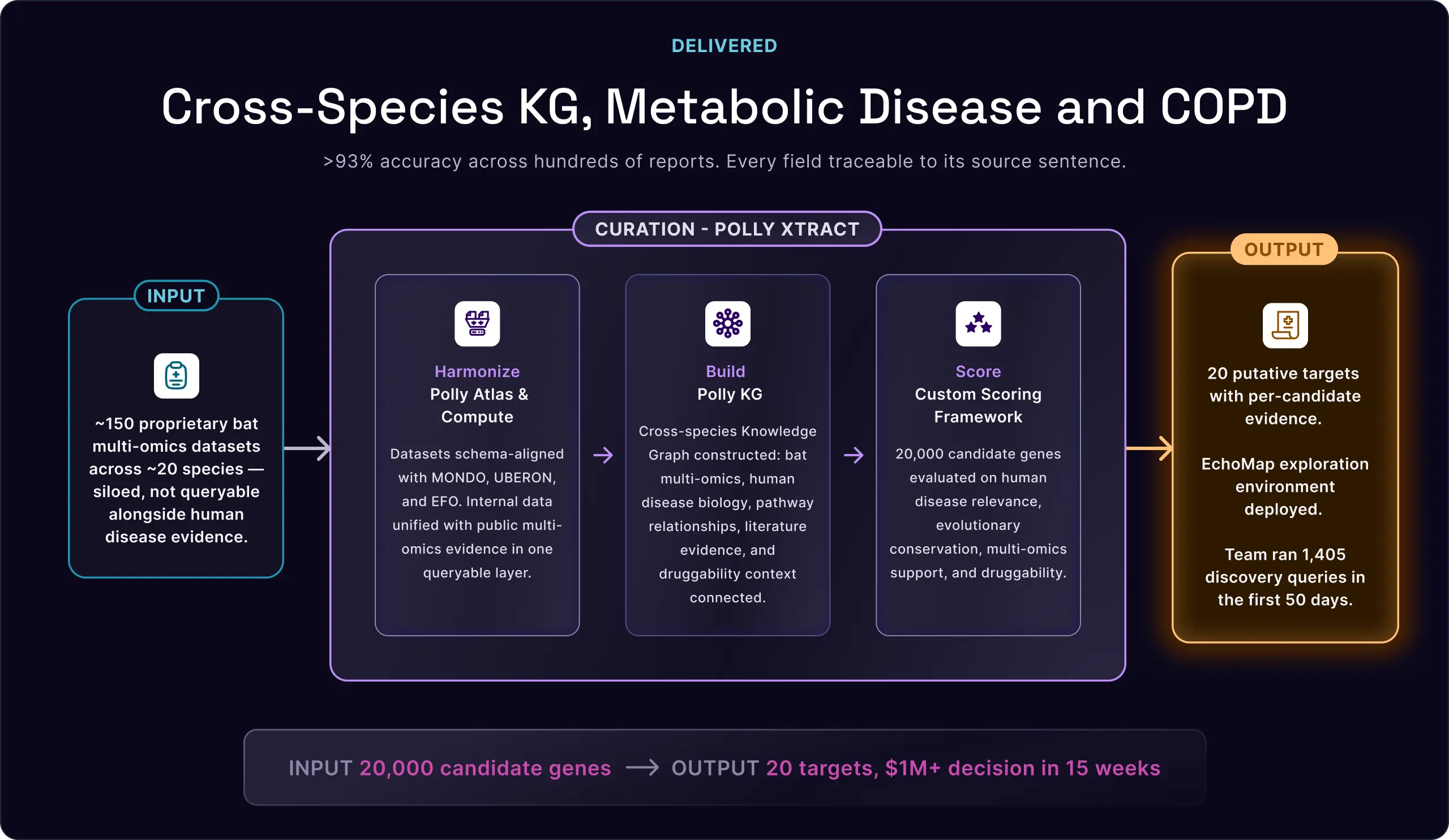
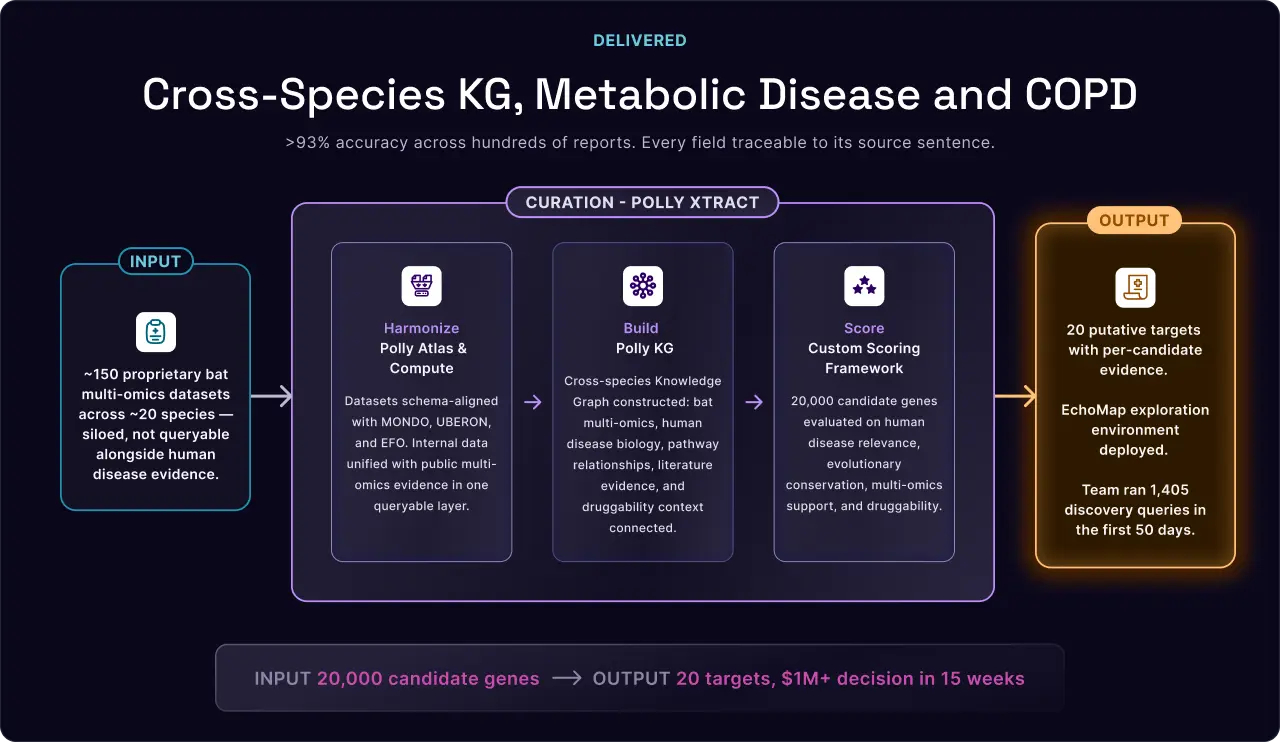
Custom scoring across disease relevance, druggability, and proprietary signal. Delivered in production for COPD, metabolic disease, and complement biology programs.
Atlas supplies the pre-harmonized data that Cohorter queries. Cohort construction starts from clean, ontology-mapped records.


The KG evidence pipeline is what differentiates Elucidata's Program Partner service from a KG license, it's the qualification layer that determines whether the graph is built on graded relationships or just co-occurrence counts.
The primary program type. Elucidata processes 8M+ full-text papers and qualifies every gene-disease relationship as supporting, contradicting, or neutral before writing a KG edge. Every edge carries direction and confidence. Delivered in production for COPD, metabolic disease, and AML programs.
The same qualified evidence layer used for target ranking requalifies relationships at the validation stage. Delivered in production for complement-mediated disease programs.
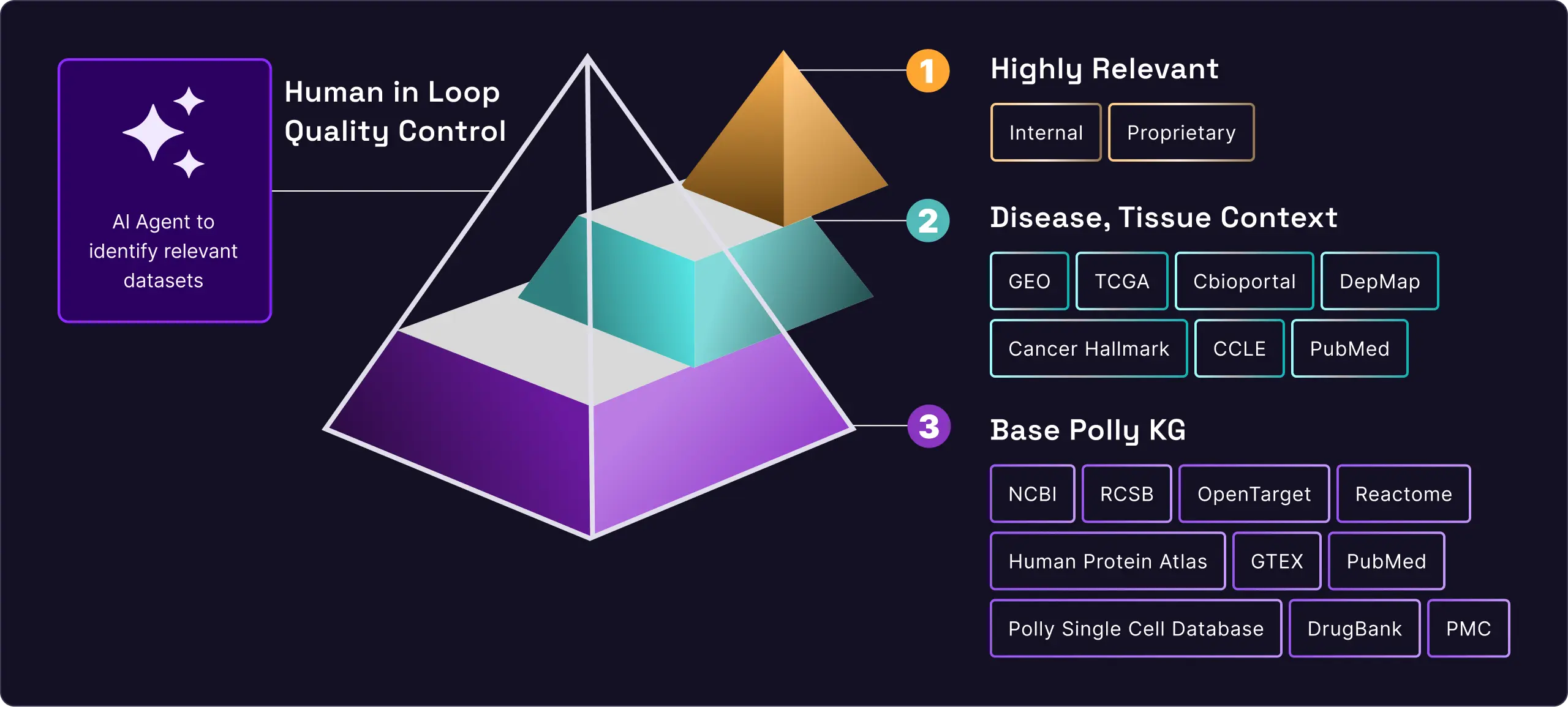
Polly KG is available as an optional evidence layer in Gene Disease Target Assessment engagements, supplying the biomedical knowledge graph that Polly Lens scores against.
We integrate Polly KG into your target ID infrastructure in the model that fits your program.
Web interface for KG exploration, target scoring dashboards, and evidence report generation via Polly Lens.
The KG MCP Server connects your AI tooling directly to Polly KG. List graphs, run Cypher, download results. In production as of Q2 2026.
We wire Polly KG into your stack via the Polly KG REST API, with Cypher and natural language queries supported and async execution for large result sets.
Guided AI research interface for querying the KG, exploring mechanisms, and generating evidence reports without writing queries. Also available via Slack integration.
Full API documentation and integration guides available on request.
Co-occurrence counts how often a gene and disease appear together. Polly's KG separates supporting from contradicting evidence before writing any edge. For target identification in drug discovery, that distinction determines which candidates make the shortlist.
Target Ranking narrows 20,000 genes to a ranked shortlist using the knowledge graph. Target Validation uses the same qualified evidence to stress-test specific candidates before wet-lab commit. Both use direction-graded evidence. The question changes: 'who should we pursue?' versus 'does this candidate hold up?'
The Polly Knowledge Graph gives your scoring layer direction-graded evidence, not raw co-occurrence counts. Candidates with mixed or contradicting evidence are flagged before they reach the shortlist.
Yes. Full-text processing recovers evidence from supplementary sections and methods text that abstract-only tools miss. Proprietary in-house datasets go through the same qualification pipeline as public literature.
PubMed Central literature is ingested continuously. Proprietary data integrates at program milestones.
The full range, from initial target discovery through target validation. The same KG that ranks 20,000 genes also carries the contradicting evidence your team needs at the validation stage.
AI models that query a co-occurrence graph amplify noise. Polly KG gives AI models qualified, direction-graded inputs, so your models start from defensible evidence.
.webp)


.webp)

.webp)


.webp)

.webp)


.webp)


.webp)

.webp)


.webp)

.webp)


.webp)


.webp)

.webp)


.webp)

.webp)


.webp)


.webp)

.webp)


.webp)

.webp)


Once the knowledge graph is built on direction-graded evidence, your target selection has something to stand on.
Single cell RNA seq and proteomics from different studies become comparable in one query, not a multi-week project.
Single cell RNA seq, spatial transcriptomics, bulk RNA-seq, and clinical data run through differential expression and cohort comparison on day one.
Atlas supplies the pre-harmonized data that Cohorter queries. Cohort construction starts from clean, ontology-mapped records.


Atlas is the data and knowledge infrastructure that runs across two Elucidata service engagements, the harmonized, continuously updated foundation the KG is built on and the layer the program team queries.
Atlas is the harmonized data foundation for spatial and GWAS programs. Single cell RNA seq, spatial transcriptomics, clinical phenotype, and GWAS data share one schema before cohort construction begins in Cohorter.
Atlas is the data store that ETL pipeline engagements write to. Every harmonized record is queryable from the day the pipeline goes live.
Atlas provides the ontology-mapped schema that makes cross-study cell annotation consistent across public and proprietary datasets.
We integrate Atlas into your program infrastructure in the model that matches your team's setup.
Web interface for KG exploration, target scoring dashboards, and evidence report generation via Polly Lens.
We wire Atlas into your pipelines via the Polly Atlas REST API, with harmonized data, schema retrieval, and full programmatic access.
The Atlas MCP Server connects your AI tooling directly to the Atlas data corpus. 7.15M PMC papers and 260k GEO datasets, queryable in plain language. In production as of Q2 2026.
Query-driven research interface that surfaces Atlas data alongside KG evidence for integrated Target ID workflows.
Full API documentation and integration guides available on request.
A data lake stores raw files. Atlas stores harmonized, ontology-mapped records with cross-study entity resolution and a unified schema for multimodal data integration queries.
25+ modalities: single cell RNA seq, spatial transcriptomics, bulk RNA-seq, proteomics, metabolomics, ATAC-seq, methylation, WES, WGS, and clinical phenotype. All go through the same data harmonization pipeline.
Spatial / GWAS / Patient Stratification (Translational), Data Flow Engineering & ETL Pipelines (Infrastructure), and Cell Annotation + Data Harmonization (Data). Atlas is the harmonized data layer those programs query or write to.
Both go through the same harmonization pipeline and live in the same schema after ingestion. Cross-modal queries mixing GEO data and proprietary data run without a separate alignment step.
Continuous ingestion across 30+ repositories. New GEO and PMC datasets processed automatically. Proprietary datasets integrate on the client's schedule.
.webp)


.webp)

.webp)


.webp)

.webp)


.webp)


.webp)

.webp)


.webp)

.webp)


.webp)


.webp)

.webp)


.webp)

.webp)


.webp)


.webp)

.webp)


.webp)

.webp)


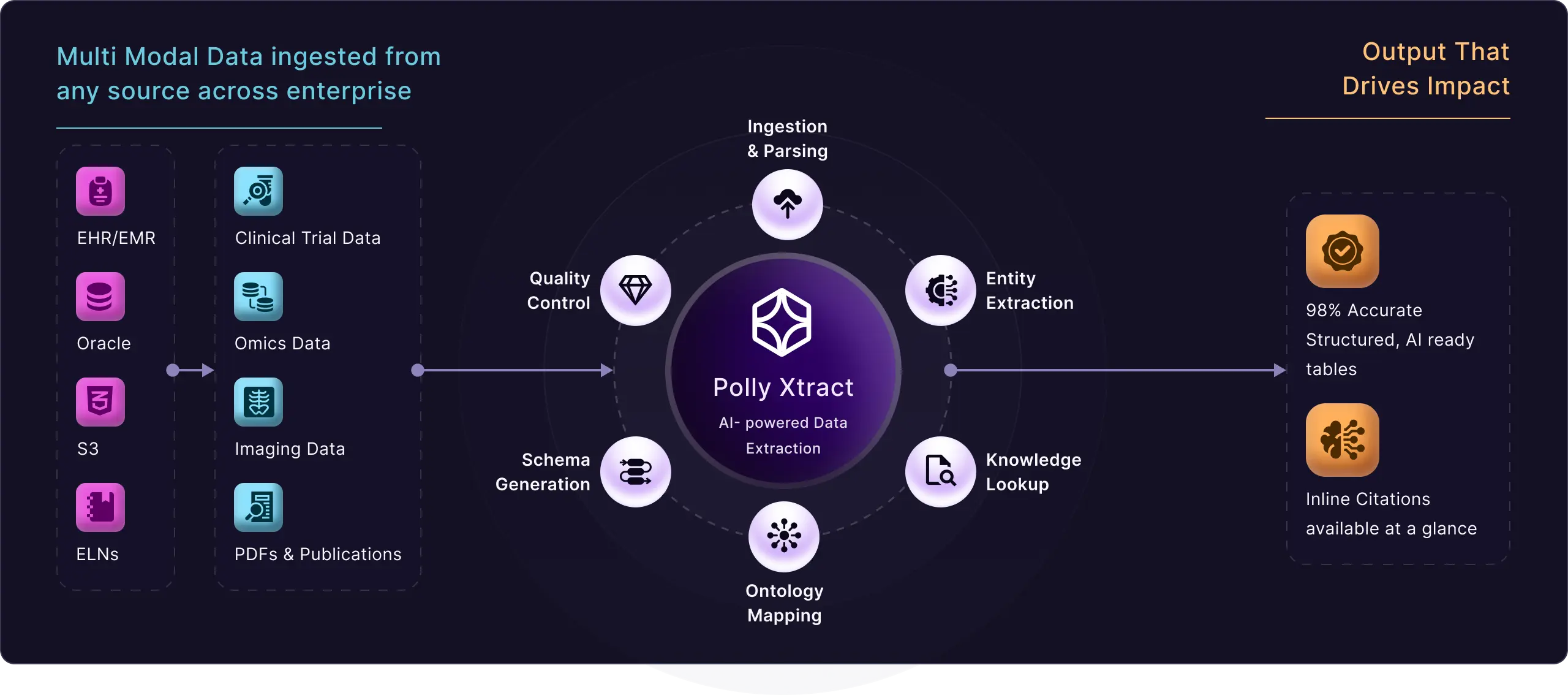
Once Xtract is running on your documents, clinical, omics and research data becomes an AI-ready asset.
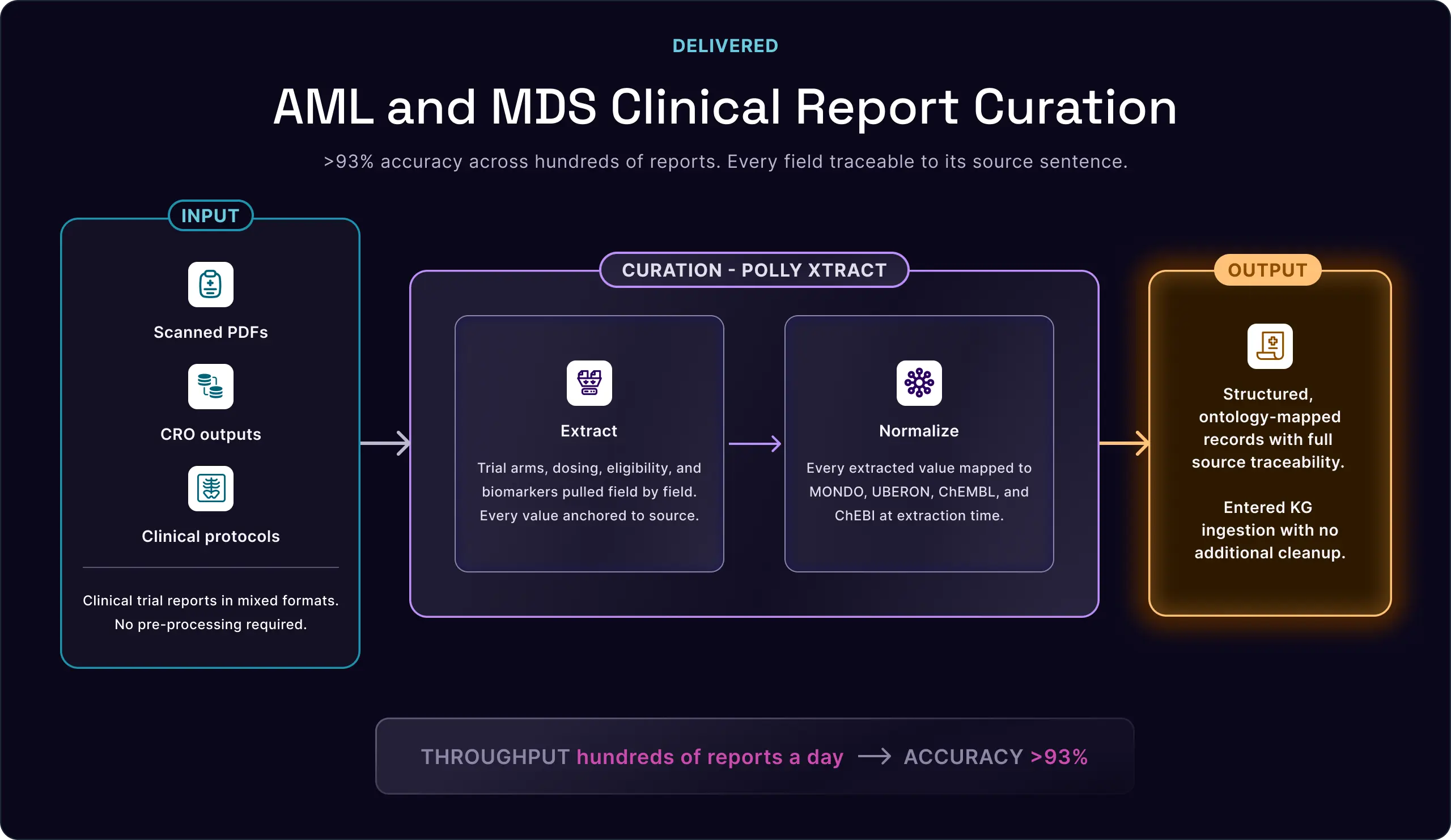
Endpoints, eligibility criteria, dosing arms, and biomarkers extracted from hundreds of reports, structured for drug discovery target identification without manual reading.
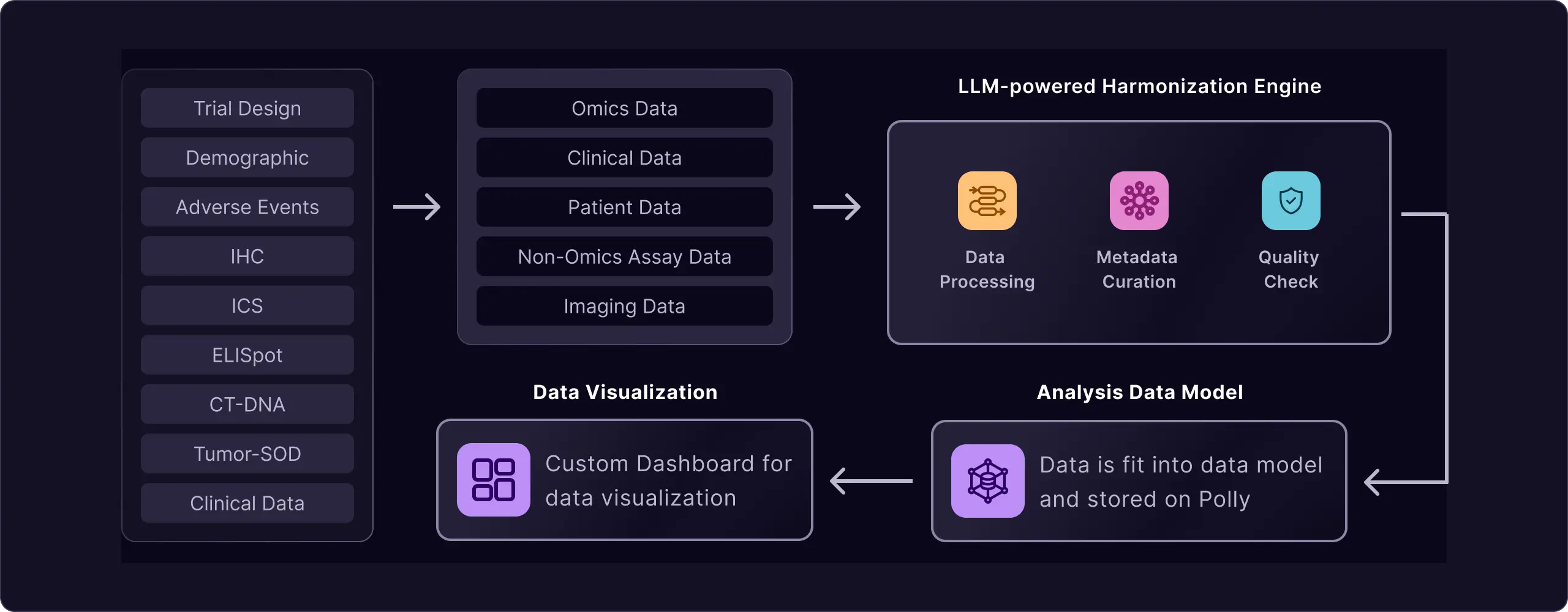
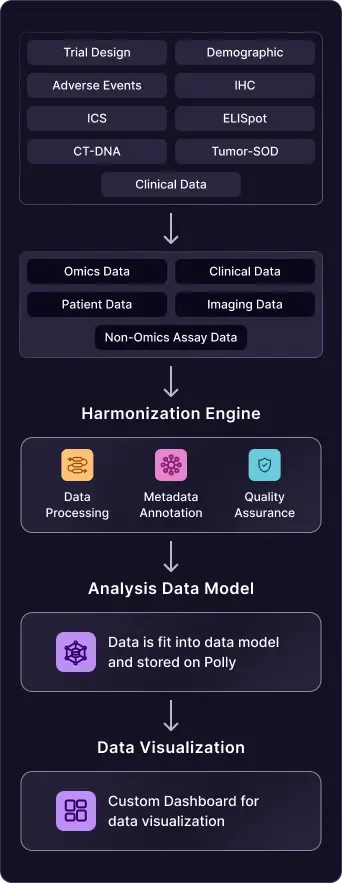
Every extracted value mapped to your schema, normalized to 17+ ontologies, and linked to its source sentence.
Every field hyperlinked to its source sentence. Reviewers interrogate the extraction, not just the result.
Polly Xtract powers the curation layer of Elucidata’s Data Partner service, converting proprietary documents into structured evidence that can be integrated into your program-specific AI / knowledge graph.
Xtract structures your proprietary documents, CRO reports, assay data, and trial protocols for ingestion into the program knowledge graph. 98% field-level accuracy.
Xtract extracts and structures validation study outputs so proprietary evidence enters the KG with full audit trails at the validation stage.
Xtract curates patient-level documents and omics metadata for spatial transcriptomics and GWAS-based programs. Structured output flows directly into Atlas and Cohorter.
We integrate Xtract into your document processing workflow in the model that fits your stack.
Web interface for document upload, schema management, extraction review, and structured data export.
We wire Xtract into your existing document processing pipelines via the Polly REST API.
Query-driven interface for exploring and validating extracted data alongside KG evidence in a single workflow.
We route Xtract outputs directly into your downstream systems, LIMS, data lakes, and KG ingestion pipelines, via API or delivery handoff.
Full API documentation and integration guides available on request.
PDFs (native and scanned), Word, spreadsheets, HTML tables, CRO reports, EMR exports, and clinical protocols. No pre-processing required.
A general LLM loses context in long documents and returns no confidence signal. Xtract's four-agent pipeline is built for machine-grade data curation at scale.
98% field-level accuracy on binary and categorical fields. In benchmarks against human expert review, Xtract processes the same volume of clinical protocols in a fraction of the time.
KG-Based Target Ranking & Co-Build, KG-Based Target Validation, and Spatial / GWAS / Patient Stratification. Xtract structures proprietary documents for KG ingestion in Program engagements, and curates patient-level data for Translational programs.
Xtract turns unstructured documents into structured records ready for knowledge graph ingestion. Proprietary evidence enters the knowledge graph with full source traceability.
Yes. Internal assay reports, LIMS exports, and regulatory submissions all go through the same pipeline.
.webp)


.webp)

.webp)


.webp)

.webp)


.webp)


.webp)

.webp)


.webp)

.webp)


.webp)


.webp)

.webp)


.webp)

.webp)


.webp)


.webp)

.webp)


.webp)

.webp)


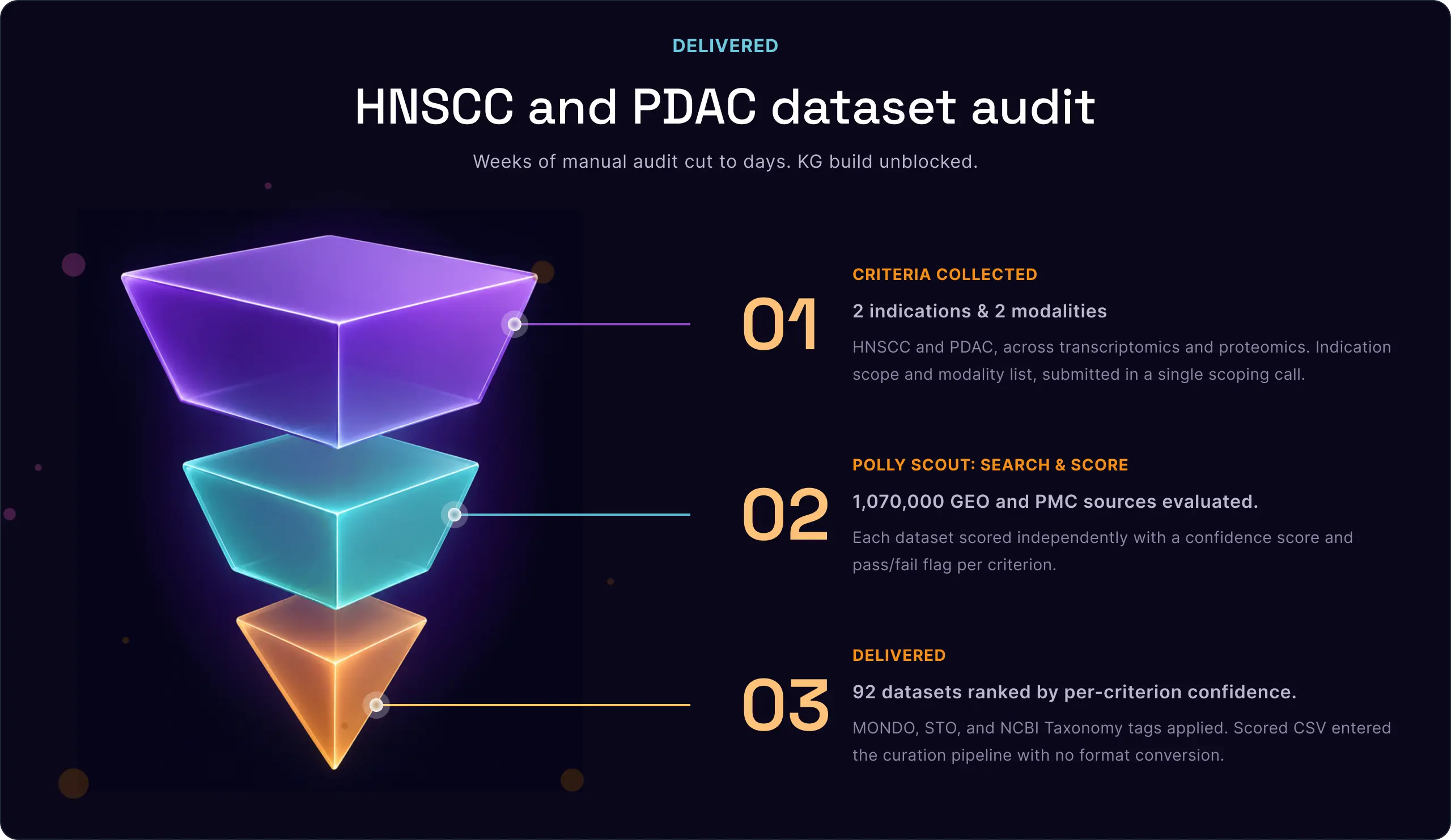
You define the criteria. Elucidata's experts run your search on Polly Scout. You review the shortlist.


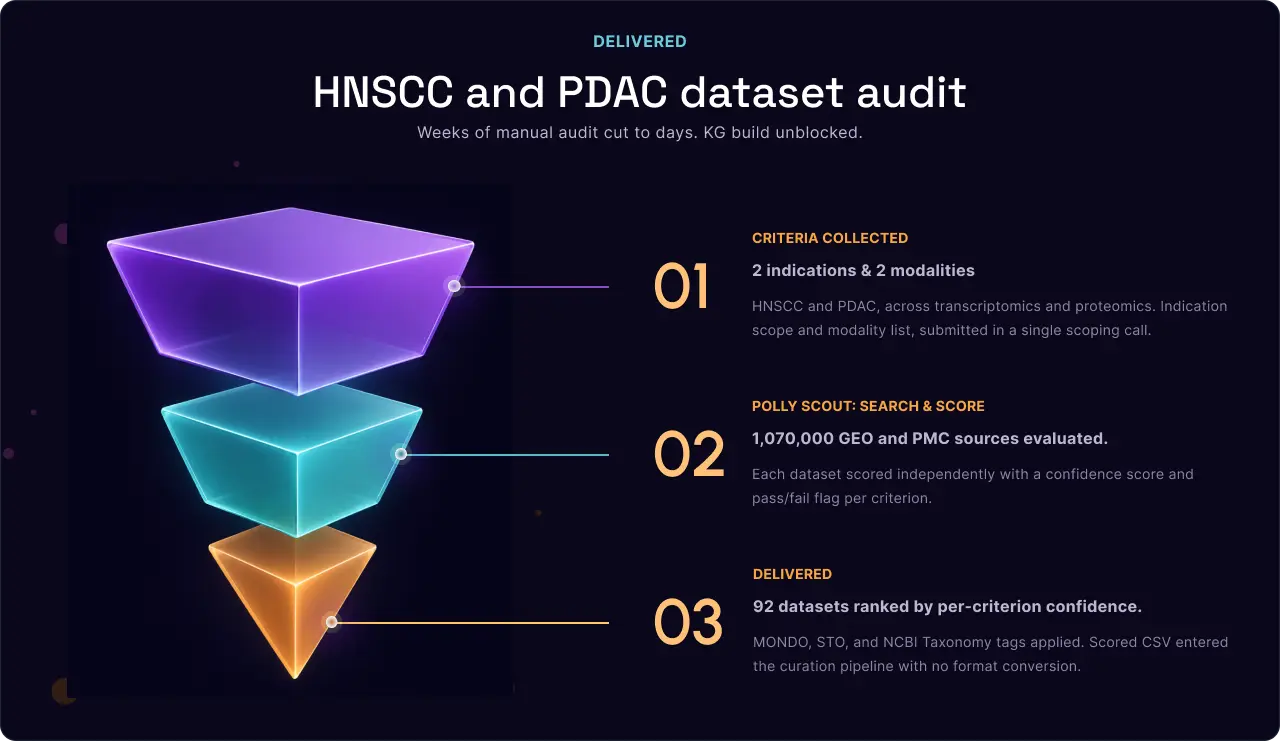
Once Scout is running on your program, dataset selection is driven by evidence coverage rather than repository familiarity.
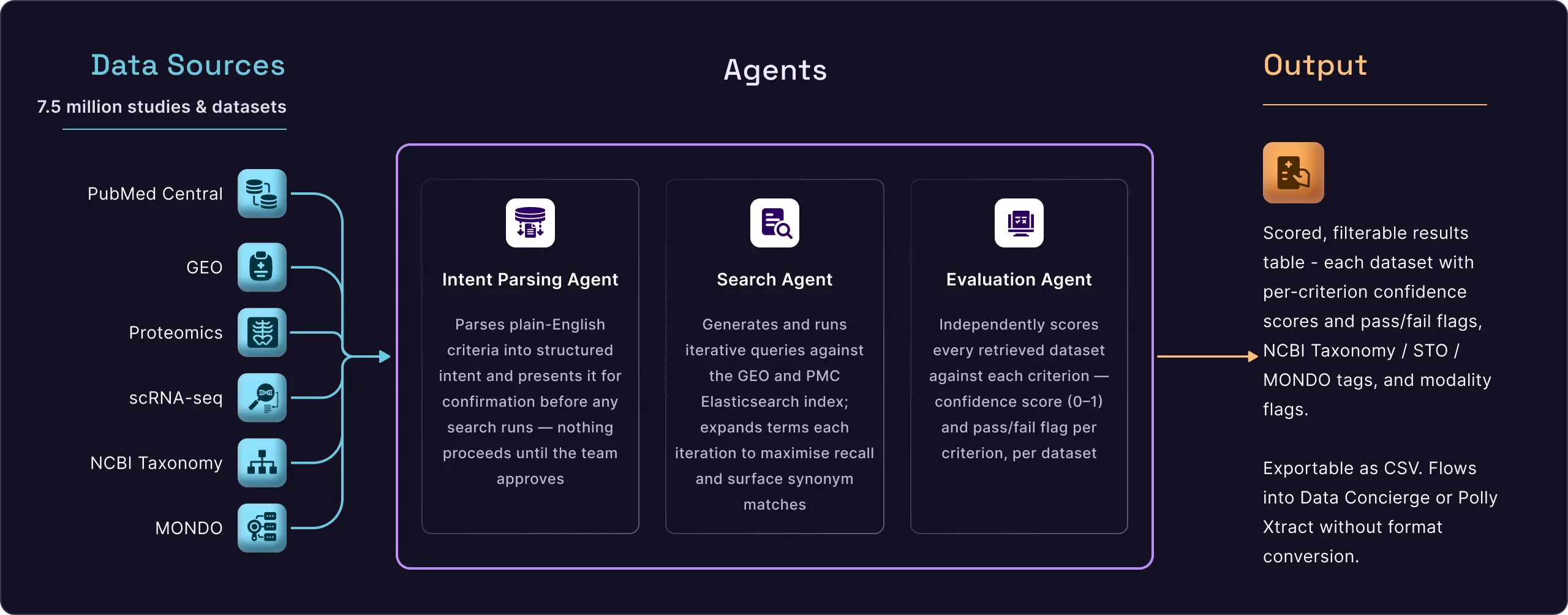
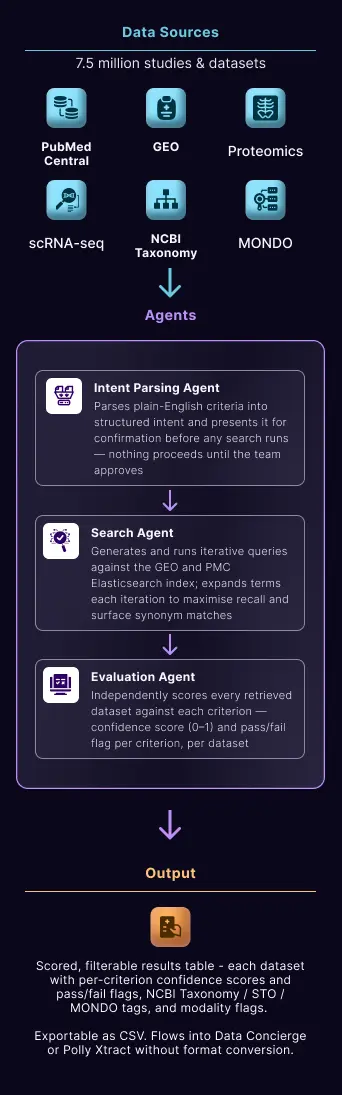
Single cell RNA seq, spatial transcriptomics, bulk RNA-seq, and 22+ modalities scored against your criteria before a single edge is written.
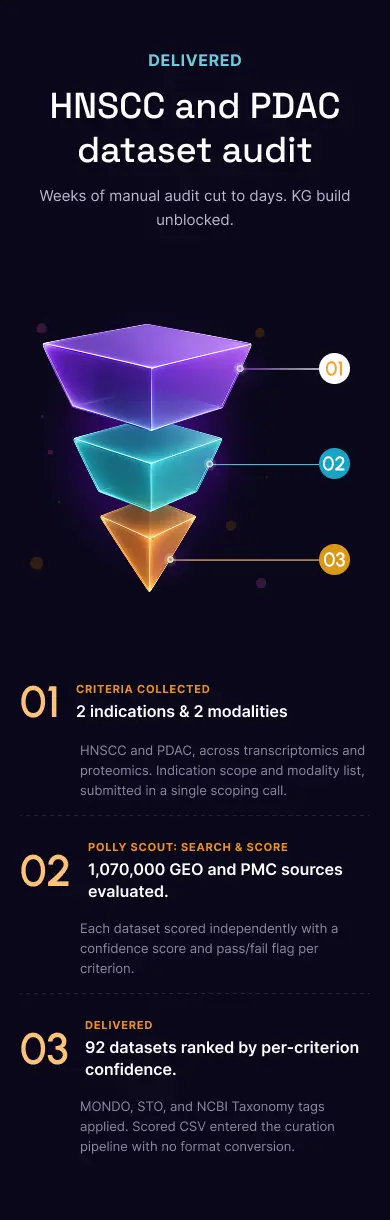
1-3 weeks compressed to a few days. Your team reviews a scored, filterable list rather than running the search.
Scored output flows into Polly Xtract or a curation pipeline with no format conversion.
Polly Scout powers the data discovery phase of Elucidata's Data Partner service, and is the first step in every Program Partner engagement where evidence completeness determines shortlist quality.
Scout runs the dataset discovery phase at the start of every KG-Based Target Ranking & Co-Build engagement. Dataset discovery, qualification, and curation for a Target ID program. Elucidata sources and delivers a fitness-for-purpose dataset package.
Scout also runs in Target Validation programs. The same dataset scouting that anchors a KG build re-qualifies the evidence base when a program shifts from ranking to validation.
We integrate Scout into your stack in the model that fits your program. Elucidata handles the run; your team works with the results.
Web interface with native Scout workflows, criteria submission, results review, batch management, and CSV export.
The Scout MCP Server connects your AI tooling directly to the Scout corpus and evaluation agents. In production as of Q2 2026.
We wire Scout into your existing data pipelines and tooling via the Polly REST API.
Query-driven research interface that pairs Scout with Polly KG for guided Target ID workflows. Also available via Slack integration.
Full API documentation and integration guides available on request.
Scout searches a pre-curated, ontology-mapped corpus of 800,000+ studies across 30+ repositories simultaneously, with multi-pass LLM filtering that understands I/E criteria semantically. Output is a ranked tiered shortlist, not a results list.
Scout is the data acquisition step. You use it to find the right public datasets before building your knowledge graph. Scout → KG build → Polly Lens evidence reports → Target Prioritization Dashboard.
No. You submit your target ID criteria. An Elucidata SME runs the audit and delivers the shortlist. Your team's involvement is at the review stage. No interface to learn, no pipeline to operate.
Standard audits complete in under 2.5 hours of calendar time. Prior manual method: 5-25 days per project.
Yes. P1 datasets flow into Polly's Data Concierge for ingestion and harmonization - 25+ modalities, 4,000+ samples/week, 30+ bioinformatics pipelines. Scout is the data acquisition phase; Data Concierge is the data preparation phase.